Have you ever sold a Filofax organiser and then later regretted it and then had to scour the internet to try and buy a replacement? May be after that particular model has been discontinued.....
So what was it? and did you find one? Tell us about it in the comments....
14 July 2012
Web Finds - 14 July 2012
Well it's a national bank holiday here in France today, although the hot sunny weather seems to have passed us by, never mind. Not such a huge list this week, but I hope there are some quality posts for you all to enjoy.
- Long overdue Midwest Meet Up Post - Miscellany from a Filofax Fanatic
- Reader Question: What do you do with filofax pages you don't need all the time - The Life of The Perpetual Student
- my filofax week #12 - Paper Lovestory
- OTF: Guest post no. 2, Nia's system - The Life of The Perpetual Student
- COMPETITION: Filofax for the Olympics! - My Flash diary
- Filofax Dilemma 101 - Imysworld
- Filo auf Reisen (6): BeNeFax, reloaded - Filomaniac
- Recycling Filofax Paper for Revision - Imysworld
- Getting Organised!! - Filo Obsessed
- Filofax Labels - It's My Life!
- Diary testing: 2PPD - Living With Liisa
- Filofax VS Sammie - My life in words
- Mein Filofax.... - Hauptsache schon und glucklich
- Plastic Envelope in a snap! - Lime Tree
- Photographic Filofax dividers template for Pocket size - My Life All in One Place
- Neue Umfrage: Welcher Holiday Essentials Filofax ist Euer Favorit - Filomaniac
- osterley: a plum surprise - Paper Lovestory
- Office cleanup unearths treaures! - Krista's Filo
- Tart up your filofax with a side order of enabling - The Crazy Suburban Mom
- Downsize and Colorize – Goodbye Comfort Zone - The Zeitgeist of Zoe
- Acid & A Filofax Update - Imysworld
- Kieran's Organiser - It's My Life
- Friday's Filofax Poll Results: You Stalker You! - Vanjilla
- Mein Freund ist aus Leder - Filomaniac
- Compact Maldens for sale - Anita Lim
- Filofax Blog of the Week: The Zeitgeist of Zoe - My Life All in One Place
- Keeping Track of Daily Life, the Old Fashioned Way - The Wall Street Journal
- another washi tape use - Paper Lovestory
- Poll result follow-up: Using more than one planner - Plannerisms
- The Summer Olympics are Coming - Joseph David Quinton
- Setup of my Travel-Filofax - We really didn't need another Filofax blog.....
- Your blog post could appear here next week if we missed you this time around. Email us the details and we will include it if we can.
- We can't guarantee people will read your posts, but we know there is a higher chance of people reading your posts and returning to read other posts if you make them interesting with pictures and good hints and tips. Don't forget to give your posts a title...
Enjoy.....
Labels:
Web
13 July 2012
Free For All Friday No. 191
I was quite surprised by the negative attitude some people get when they are seen to own more than one Filofax personal organiser, remember the old saying though 'Sticks and stones will break my bones but words will never hurt me' Yes something my late mother taught me when I was being bullied at school.
Personally I think it's envy, we are being different by using paper rather than going along with the herd of only using electronic gadgets. Not that we don't use electronic gadgets ourselves, but we have found what works best for us. People might pock fun, but just ignore them, don't let them persuade you to change.
I've found more people that look at it in a positive way myself. Sure I get a few people joke about it, but they are quickly silenced when I tell them about Philofaxy and how popular it is!
So let us not dwell on that topic, after all it's Friday and you are free to discuss anything Filofax related.
Labels:
FFAF
12 July 2012
Guest Post: In search of the ultimate compact A5 Filofax – Part 2
OK - so you missed yesterday? Where were you? Here’s a quick resumé! I’ve resisted switching to a personal size organiser and I've now made my own A5 “Filoflex”. It’s a standard Flex by Filofax cover fitted with a 13mm binder ring (ex. Time Manager). Now I’ve just got to decide what to put in it!
Big problem. How on earth could I get everything from my 25mm ringed A5 Holborn into a mechanism barely half the size? Put simply, I couldn't! So, I thought long and hard about what I really needed to carry around. I undertook a week long trial with my A5 Holborn, putting a little dot at the top of every page when I used it. I suppose I shouldn't have been surprised at the results. 60% of my pages were never looked at all week and a further 20% could easily be discarded if I used my iPhone (boo! hiss!) more efficiently and avoided duplication of information. In particular, why did I need to carry all my contacts on my 'phone and an identical set in my organiser in printed form? I think this one comes from the days when 'phone batteries were poor and likely to give up at a crucial moment!
I think some tasks still can't be done effectively on a smartphone. For example, a foldout year planner is a great way for your advance planning overview. It’s far better than trying to plan on a tiny ‘phone screen. Paper is the best way for structured thinking too - for example designing this post so it flowed smoothly. (hmmm!)
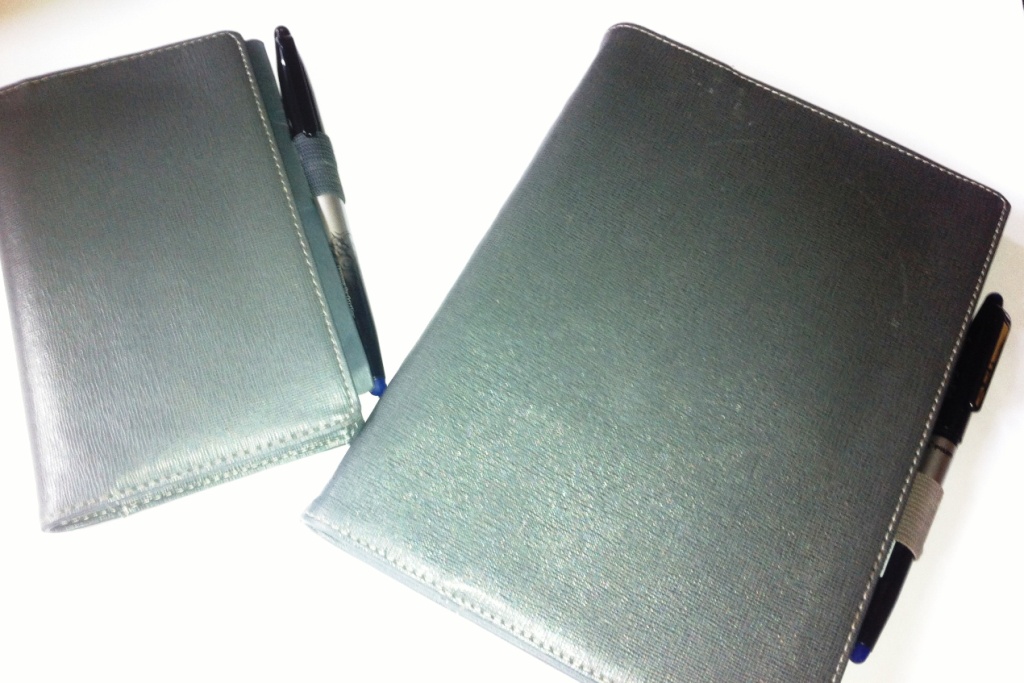
So I sat down and went through everything I needed each day and the best way - and indeed from now on, the only way - of carrying it around. I included everything I used on a daily basis – debit cards, credit cards, business cards, stamps, a pen, the need for pockets for money, receipts, tickets etc. As well as my A5 Flex and iPhone, I realised that I would ideally also have a new smaller-size wallet. I decided that a Slim Flex would fit the bill – as well as matching my grey slate A5 Flex.
Here's the list of things I went through and where it seemed to fit best (Time Manager fans will recognise my TMI thought processes!):
Flex A5 (with ring) - * indicates items to be held in the ring mechanism
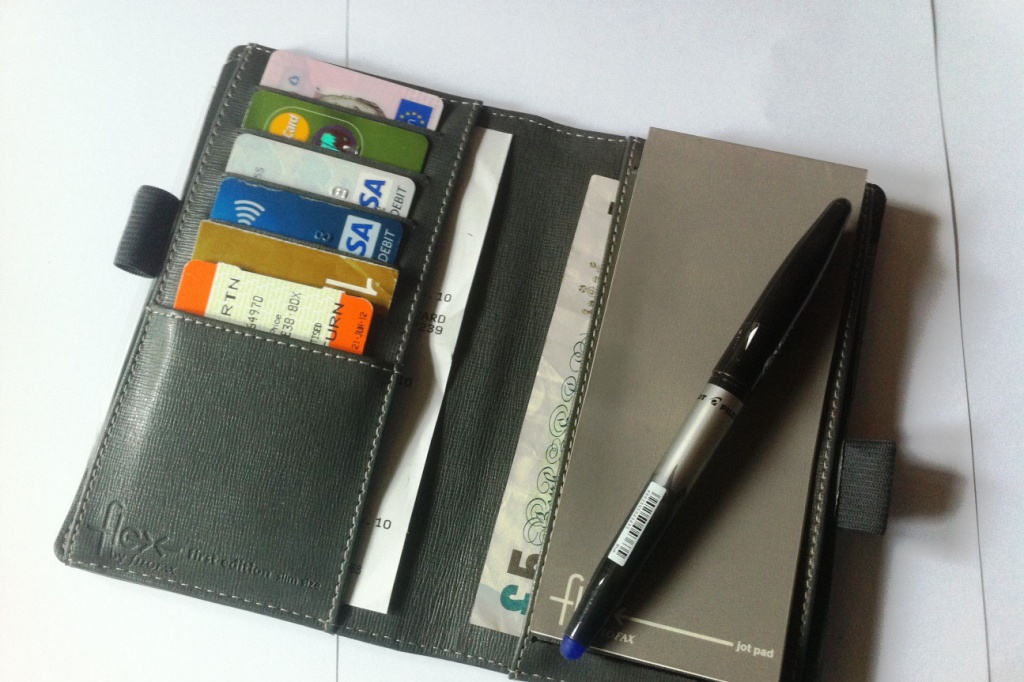
Flex Slim
iPhone4 (no photo needed!)
It has worked brilliantly! So much so that I've hardly changed anything in 12 months. Initially, I originally also had a Flex fold out year planner in the Slim wallet. I quickly abandoned that as I found I only do long-term planning when I’ve got the A5 with me (i.e. not in the pub!)
Due to the number of cards we seem to need these days (loyalty cards, membership cards, discount cards etc) I added extra cards to the Slim wallet by cutting down a couple of clear business card holders. Each holds four (back-to-back) and they sit in the outside pockets with the pen holders (that also act as the wallet closure). This means I don’t even need to open the wallet to remove one of these cards and can now hold 14 rather than 6.
As you’ll have noticed, I’m still using the spliced and punched Flex diary pages in my A5. When these run out at the end of July (it was a 2011/2 academic year Flex diary which they haven’t produced this year), I’ll switch to printing my own using the Steve n’Ray “enhanced time management” templates (which I also had a tiny say in the design of!) CLICK HERE
This photo shows how the A5 binder normally looks on my desk. I have the month/year overview on the left and the diary pages open next to that. I can then flip directly to project or information pages as I need to. Two folds and I can pick up the binder with thumb and two fingers, just needing to fit the Frixion into the two elasticated holders and I’m off!
If you love carrying a big A5 Filofax and having everything in printed paper form, then this isn't for you. If however, you largely use an iPhone (or other smartphone), iPad or whatever, but still love paper and just need to keep a few core pages of overview, journal, project management info and blank pages for jotting down ideas, planning and making notes, then this type of approach is certainly worth thinking about.
Finally, if you’re still not sure I’ve done the right thing, here are the size and weigh-in comparisons - all with contents:
Filofax A5 Logic zipped (black)
265mm x 205mm x 48mm = 2,607,600 cubic millimetres.
Typical weight: 1650g
Filofax A5 Holborn (brown)
235mm x 195mm x 38mm = 1,741,350 cubic millimetres
Typical weight: 1320g
Flex by Filofax A5 First Edition as modified (grey)
223mm x 165mm x 25mm = 919,875 cubic millimetres.
Typical weight: 425g
..and for those of you that think an A5 Filofax is a bit like carrying a brick, here’s a comparison with one!
British Victorian Housebrick
200mm x 115mm x 79mm = 1,817,000 cubic millimetres
Typical weight: 2700g – so about the same capacity as a loaded A5 Holborn and twice as heavy!
Hope you’ve found this of interest. All the photos except one, have just been taken, so show the set-up after 12 months of daily use. So, even though it’s vinyl and not leather, it has worn pretty well.
I wrote to Letts Filofax about my experiences and made a few suggestions. Sure enough, I didn’t even get an acknowledgement! Their customer service is good but their attitude to product development and lack of interest in suggestions from serious and enthusiastic users, staggers me!
Thank you for reading. Thanks too for all the hard work the editorial team puts in and to everyone for all the banter, e-mail exchanges and helpful tips I’ve had from members of the Philofaxy community over the years!
Tim Edwards – Yorkshire Dales UK
Thank you Tim, I hope it has given some of our readers some ideas to help create their own Filoflex (TiM)
Big problem. How on earth could I get everything from my 25mm ringed A5 Holborn into a mechanism barely half the size? Put simply, I couldn't! So, I thought long and hard about what I really needed to carry around. I undertook a week long trial with my A5 Holborn, putting a little dot at the top of every page when I used it. I suppose I shouldn't have been surprised at the results. 60% of my pages were never looked at all week and a further 20% could easily be discarded if I used my iPhone (boo! hiss!) more efficiently and avoided duplication of information. In particular, why did I need to carry all my contacts on my 'phone and an identical set in my organiser in printed form? I think this one comes from the days when 'phone batteries were poor and likely to give up at a crucial moment!
I think some tasks still can't be done effectively on a smartphone. For example, a foldout year planner is a great way for your advance planning overview. It’s far better than trying to plan on a tiny ‘phone screen. Paper is the best way for structured thinking too - for example designing this post so it flowed smoothly. (hmmm!)
So I sat down and went through everything I needed each day and the best way - and indeed from now on, the only way - of carrying it around. I included everything I used on a daily basis – debit cards, credit cards, business cards, stamps, a pen, the need for pockets for money, receipts, tickets etc. As well as my A5 Flex and iPhone, I realised that I would ideally also have a new smaller-size wallet. I decided that a Slim Flex would fit the bill – as well as matching my grey slate A5 Flex.
Here's the list of things I went through and where it seemed to fit best (Time Manager fans will recognise my TMI thought processes!):
Flex A5 (with ring) - * indicates items to be held in the ring mechanism
- Long-term planner – year/ month (Flex)
- Short-term planner/ Journal*
- Goals for the year (business and personal)*
- Key areas*
- Current projects (tasks and activities)*
- Core information (passwords, overnight packing, grocery list etc)*
- Blank pages*
- Mind mapping pages*
- Business leaflets and business cards
- Pen (held in two Flex card holders)
- Jot pad (Flex)
Flex Slim
- Bank notes pocket
- Receipts pocket
- Jot pad (Flex)
- Business cards
- Credit/ debit/ membership cards
- Rail and other tickets
- Pen (in 2 Flex card holders)
iPhone4 (no photo needed!)
- Contacts
- Agenda (I use the “weekcal” app as it has a weekly and mini-month view)
- Reminders/ to-do/ don't forget (I use the “tasklist” app)
- Key dates - birthdays etc (reminders by “weekcal” synced with MS Outlook)
It has worked brilliantly! So much so that I've hardly changed anything in 12 months. Initially, I originally also had a Flex fold out year planner in the Slim wallet. I quickly abandoned that as I found I only do long-term planning when I’ve got the A5 with me (i.e. not in the pub!)
Due to the number of cards we seem to need these days (loyalty cards, membership cards, discount cards etc) I added extra cards to the Slim wallet by cutting down a couple of clear business card holders. Each holds four (back-to-back) and they sit in the outside pockets with the pen holders (that also act as the wallet closure). This means I don’t even need to open the wallet to remove one of these cards and can now hold 14 rather than 6.
As you’ll have noticed, I’m still using the spliced and punched Flex diary pages in my A5. When these run out at the end of July (it was a 2011/2 academic year Flex diary which they haven’t produced this year), I’ll switch to printing my own using the Steve n’Ray “enhanced time management” templates (which I also had a tiny say in the design of!) CLICK HERE
This photo shows how the A5 binder normally looks on my desk. I have the month/year overview on the left and the diary pages open next to that. I can then flip directly to project or information pages as I need to. Two folds and I can pick up the binder with thumb and two fingers, just needing to fit the Frixion into the two elasticated holders and I’m off!
If you love carrying a big A5 Filofax and having everything in printed paper form, then this isn't for you. If however, you largely use an iPhone (or other smartphone), iPad or whatever, but still love paper and just need to keep a few core pages of overview, journal, project management info and blank pages for jotting down ideas, planning and making notes, then this type of approach is certainly worth thinking about.
Finally, if you’re still not sure I’ve done the right thing, here are the size and weigh-in comparisons - all with contents:
Filofax A5 Logic zipped (black)
265mm x 205mm x 48mm = 2,607,600 cubic millimetres.
Typical weight: 1650g
Filofax A5 Holborn (brown)
235mm x 195mm x 38mm = 1,741,350 cubic millimetres
Typical weight: 1320g
Flex by Filofax A5 First Edition as modified (grey)
223mm x 165mm x 25mm = 919,875 cubic millimetres.
Typical weight: 425g
..and for those of you that think an A5 Filofax is a bit like carrying a brick, here’s a comparison with one!
British Victorian Housebrick
200mm x 115mm x 79mm = 1,817,000 cubic millimetres
Typical weight: 2700g – so about the same capacity as a loaded A5 Holborn and twice as heavy!
Hope you’ve found this of interest. All the photos except one, have just been taken, so show the set-up after 12 months of daily use. So, even though it’s vinyl and not leather, it has worn pretty well.
I wrote to Letts Filofax about my experiences and made a few suggestions. Sure enough, I didn’t even get an acknowledgement! Their customer service is good but their attitude to product development and lack of interest in suggestions from serious and enthusiastic users, staggers me!
Thank you for reading. Thanks too for all the hard work the editorial team puts in and to everyone for all the banter, e-mail exchanges and helpful tips I’ve had from members of the Philofaxy community over the years!
Tim Edwards – Yorkshire Dales UK
Thank you Tim, I hope it has given some of our readers some ideas to help create their own Filoflex (TiM)
Labels:
Flex,
guest post,
TMI
11 July 2012
Guest Post: In search of the ultimate compact A5 Filofax – Part 1 By:Tim Edwards
A big thank you to Tim for this excellent (picture heavy) guest post about his Flex which has rings in it... read on.. and as it says at the end Part 2 is tomorrow.
They say that size isn’t important. But not a week goes by on Philofaxy without the topic cropping up – particularly A5 versus Personal size. Is the original the way to go for compactness and portability? Or is A5 the better bet, combining extra page space and ease of printing information sheets for inserting into your binder? (I know this doesn’t apply in the USA or Canada, where you’ve yet to switch to the international paper size standard. Hey guys! Even the UK adopted it - in 1959 - and we’re not usually with the avant-garde!)
It’s certainly not a new topic. I've been having this debate with myself since 1986 when I purchased my first organiser. It was an A5 vinyl Time Manager system. Tens of thousands in the UK and around the world went on the TMI two-day course which got you the organiser system. If (like me) you weren’t high enough up the greasy pole to go, you had to buy it yourself and read about how to use it in your own time! It was available in two sizes and I chose A5 rather than the 'original' version (which was the equivalent and key competitor to Filofax). I was persuaded by the roomier pages, and (as a left-hander) being better able to work around the binder rings when writing. Even so, I soon got fed-up lugging the bulky A5 binder around due to its’ size and weight.
Even in the 1980’s, portability was becoming an issue. So, when TMI introduced their Compact binder in 1989, I purchased one. It was a great size for carrying around, but hopeless for inserting any printout information (agenda’s, contacts etc).
My A5 was soon confined to the desk and major conferences, but even then often replaced by a Psion electronic organiser (remember them?)
Filofax didn't introduce A5 until around 1991 and it was only when I migrated to their Time Management system in 2004 that I again found myself unhappy with the bulk of an A5 zipped monster. This time a nylon faced Logic binder – typical weight with contents 1.6Kg! Indestructible. Built like a tank. It felt like I was going back in time!
So out came my Time Manager compact again and a few pages switched between that and the Logic-zipped. One day (probably having dropped the Logic on my toe again!) I purchased a reduced price A5 Kendal. I was trying to get to "one life, one Filofax"! OK! it was smaller and a bit lighter, but not slimmer (still 30mm rings).
Last year when the A5 Holborn came out (with 25mm rings), I purchased one of these. However, like many Philofaxy readers have found, being A5, it was still bulky to carry around everywhere. I was finding that the looks of admiration I got 20 years ago when whipping out my well-structured, professional-looking A5, were now being met with glances of pity. I remember one meeting when I was sat thumbing through my rather obese Filofax and a colleague very vocally recalled: “Oh! I used to have one of those things” before giving everyone an unrequested demonstration of the merits of his new iPad! But, he did have a point. 20 years before, everyone in the room would have had a paper organiser. Now I was the only one! But, I still enjoyed a paper-based system and had no wish to go completely digital. I just needed a way to stick with A5!
Then came the Flex by Filofax announcement. I instantly recognised the Flex design as a direct copy of the 1980's Time Manager Planner Wallet. To be fair this had never been produced by TMI in A5. I was one of the first to buy a Flex - motivated by a brilliant video by Imy of Imysworld Unfortunately, Imy took the video off (she told me it was a bit embarrassing), but there is still a great review by Imy here; and Steve did a review too.
Could I abandon a ringed system and use a ringless Flex? Well, I tried for a few days. Honestly, I did! But I quickly got frustrated at not being able to move pages around into order. Without a ring I couldn’t add new sheets or remove others. Also, I only use my diary as a journal. All appointments have long since been coordinated through Microsoft Outlook and synced to my 'phone. So carrying a full 12 month blank diary and a big empty notebook wasn't for me.
So, If not Flex - what might work? I loved the Flex binder size. It slotted into a small pocket in my briefcase and took up little room in a rucksack or day bag. OK - the plastic vinyl material is dire but I could predict from the outset that leather versions would follow, if I waited (I’m still waiting!). We've long campaigned for a slim A5 Filofax (no, not Adelphi) but with no prospect of a decent slimline compact A5 being launched (this was June last year) which way could I go?
After close examination of my A5 Flex, I realised that there was potential. I could fit a slim ring mechanism into the spine and still use the Flex in the intended way - both the inside and outside pockets. After a trial with a ring fixed to a flexible insert (similar to the pen holder) I found that the 13mm ring from my old Time Manager Compact worked well. Indeed, so well that I confidently took a modelling knife to my virtually new Flex one evening and fitted the ring to the spine. TMI don’t use rivets for their compact mechanisms, so the two-piece ring mechanism was fairly quickly fitted to the Flex. In minutes, it was transformed to become my first compact A5 organiser!
Here’s how I did it… Important: this technique involves using a sharp modelling knife. If you were to use a riveted Filofax ring mechanism, you would also need a sharp instrument such as a pocket screwdriver. This is not a recommendation for anyone to do what I did. Proceed with the greatest care and at your own risk if you are tempted to try anything similar!
As mechanisms are not sold separately, my only option was to use one from an old organiser. I removed the 13mm ring from my old Time Manager Compact. If anyone wants to try to source one, they are made by a small Swiss company called “Krause”. (Note that newer TMI Compacts have 17mm rings as the smaller ones were regarded as too small!). Filofax mechanisms are made in China by a company called “World Wide”. I suspect they would want a minimum export order of several thousand! Such is life! [See Note 1]
First, I carefully unclipped and removed the mechanism. I worked out exactly where it was to go in the Flex and where I needed to make two holes in the inner cover. I then, VERY CAREFULLY, cut the holes ensuring that I only cut through the inner layer of plastic and not through the separate outer layer. The holes didn’t need to be too neat as they would be covered by the mechanism.
The TMI compact mechanism is in two parts that just clip together.
I applied some impact adhesive (Evo-stick – other brands are available!) to the baseplate and carefully pushed the plate through the bottom hole I had made, pushing it up past the top hole and checking it was correctly aligned.
I then offered up the ring mechanism sliding it onto the two sets of lugs on the baseplate..
..and finally checking that the lugs had engaged correctly with the ring mechanism.
This is how it looked when complete
Fitting a Filofax mechanism would be harder as mechanisms are held by two rivets protruding from the baseplate. It can be tried by gentle easing the lip of the rivets up using a pocket screwdriver (with great care to avoid scratching the chrome and to avoid personal injury!)…
…then removing the mechanism from the baseplate…
… then proceed in reverse having fitted the baseplate inside the Flex cover.
Just as the glue had dried, I realised that by moving the binder ring slightly off -centre (slightly lower) I could have created enough space for some dividers with tabs on the top without them sticking out at all. So I unclipped the mechanism, gently eased the glued baseplate off and re-glued it a few millimetres lower. It worked perfectly! My dividers were made from Time Manager storage box dividers, suitably punched, but they could have been easily cut from plastic.
I decided that three tabs would be a suitable compromise – basically a section for my work, one for personal and a third for information.
Despite what this photo suggests, the tabs don’t protrude from the top or the dividers stick out at the bottom of the binder – they are just flush as you can see (or not see!) here…
There was the issue of the hole spacing being different to Filofax A5 (TMI use the same spacing as Filofax Personal). However, having been long unhappy with Filofax insert quality, I decided to use up my stock of old Time Manager inserts (some over 20 years old but still better quality than modern Filofax paper). As for diary/ journal pages my modelling knife soon converted the Flex diary into loose leaf format (Steve by coincidence did the same thing a few months later). I used my solid robust TMI hole punch to make the correctly spaced holes in the cotton cream paper and they’ve been fine.
So, could I fit everything I needed into my new "Filoflex"? Or would I fail and end up back with a traditional A5 Filofax? Or would I give-in altogether and succumb to the temptation of going Personal?
Find out in part two, tomorrow...
Note 1: Steve found some suppliers of ring mechanisms in this post on creating your own organiser. Additionally I tracked down two other companies:
They say that size isn’t important. But not a week goes by on Philofaxy without the topic cropping up – particularly A5 versus Personal size. Is the original the way to go for compactness and portability? Or is A5 the better bet, combining extra page space and ease of printing information sheets for inserting into your binder? (I know this doesn’t apply in the USA or Canada, where you’ve yet to switch to the international paper size standard. Hey guys! Even the UK adopted it - in 1959 - and we’re not usually with the avant-garde!)
It’s certainly not a new topic. I've been having this debate with myself since 1986 when I purchased my first organiser. It was an A5 vinyl Time Manager system. Tens of thousands in the UK and around the world went on the TMI two-day course which got you the organiser system. If (like me) you weren’t high enough up the greasy pole to go, you had to buy it yourself and read about how to use it in your own time! It was available in two sizes and I chose A5 rather than the 'original' version (which was the equivalent and key competitor to Filofax). I was persuaded by the roomier pages, and (as a left-hander) being better able to work around the binder rings when writing. Even so, I soon got fed-up lugging the bulky A5 binder around due to its’ size and weight.
Even in the 1980’s, portability was becoming an issue. So, when TMI introduced their Compact binder in 1989, I purchased one. It was a great size for carrying around, but hopeless for inserting any printout information (agenda’s, contacts etc).
My A5 was soon confined to the desk and major conferences, but even then often replaced by a Psion electronic organiser (remember them?)
Filofax didn't introduce A5 until around 1991 and it was only when I migrated to their Time Management system in 2004 that I again found myself unhappy with the bulk of an A5 zipped monster. This time a nylon faced Logic binder – typical weight with contents 1.6Kg! Indestructible. Built like a tank. It felt like I was going back in time!
So out came my Time Manager compact again and a few pages switched between that and the Logic-zipped. One day (probably having dropped the Logic on my toe again!) I purchased a reduced price A5 Kendal. I was trying to get to "one life, one Filofax"! OK! it was smaller and a bit lighter, but not slimmer (still 30mm rings).
Last year when the A5 Holborn came out (with 25mm rings), I purchased one of these. However, like many Philofaxy readers have found, being A5, it was still bulky to carry around everywhere. I was finding that the looks of admiration I got 20 years ago when whipping out my well-structured, professional-looking A5, were now being met with glances of pity. I remember one meeting when I was sat thumbing through my rather obese Filofax and a colleague very vocally recalled: “Oh! I used to have one of those things” before giving everyone an unrequested demonstration of the merits of his new iPad! But, he did have a point. 20 years before, everyone in the room would have had a paper organiser. Now I was the only one! But, I still enjoyed a paper-based system and had no wish to go completely digital. I just needed a way to stick with A5!
Then came the Flex by Filofax announcement. I instantly recognised the Flex design as a direct copy of the 1980's Time Manager Planner Wallet. To be fair this had never been produced by TMI in A5. I was one of the first to buy a Flex - motivated by a brilliant video by Imy of Imysworld Unfortunately, Imy took the video off (she told me it was a bit embarrassing), but there is still a great review by Imy here; and Steve did a review too.
Could I abandon a ringed system and use a ringless Flex? Well, I tried for a few days. Honestly, I did! But I quickly got frustrated at not being able to move pages around into order. Without a ring I couldn’t add new sheets or remove others. Also, I only use my diary as a journal. All appointments have long since been coordinated through Microsoft Outlook and synced to my 'phone. So carrying a full 12 month blank diary and a big empty notebook wasn't for me.
So, If not Flex - what might work? I loved the Flex binder size. It slotted into a small pocket in my briefcase and took up little room in a rucksack or day bag. OK - the plastic vinyl material is dire but I could predict from the outset that leather versions would follow, if I waited (I’m still waiting!). We've long campaigned for a slim A5 Filofax (no, not Adelphi) but with no prospect of a decent slimline compact A5 being launched (this was June last year) which way could I go?
After close examination of my A5 Flex, I realised that there was potential. I could fit a slim ring mechanism into the spine and still use the Flex in the intended way - both the inside and outside pockets. After a trial with a ring fixed to a flexible insert (similar to the pen holder) I found that the 13mm ring from my old Time Manager Compact worked well. Indeed, so well that I confidently took a modelling knife to my virtually new Flex one evening and fitted the ring to the spine. TMI don’t use rivets for their compact mechanisms, so the two-piece ring mechanism was fairly quickly fitted to the Flex. In minutes, it was transformed to become my first compact A5 organiser!
Here’s how I did it… Important: this technique involves using a sharp modelling knife. If you were to use a riveted Filofax ring mechanism, you would also need a sharp instrument such as a pocket screwdriver. This is not a recommendation for anyone to do what I did. Proceed with the greatest care and at your own risk if you are tempted to try anything similar!
As mechanisms are not sold separately, my only option was to use one from an old organiser. I removed the 13mm ring from my old Time Manager Compact. If anyone wants to try to source one, they are made by a small Swiss company called “Krause”. (Note that newer TMI Compacts have 17mm rings as the smaller ones were regarded as too small!). Filofax mechanisms are made in China by a company called “World Wide”. I suspect they would want a minimum export order of several thousand! Such is life! [See Note 1]
First, I carefully unclipped and removed the mechanism. I worked out exactly where it was to go in the Flex and where I needed to make two holes in the inner cover. I then, VERY CAREFULLY, cut the holes ensuring that I only cut through the inner layer of plastic and not through the separate outer layer. The holes didn’t need to be too neat as they would be covered by the mechanism.
The TMI compact mechanism is in two parts that just clip together.
I applied some impact adhesive (Evo-stick – other brands are available!) to the baseplate and carefully pushed the plate through the bottom hole I had made, pushing it up past the top hole and checking it was correctly aligned.
I then offered up the ring mechanism sliding it onto the two sets of lugs on the baseplate..
..and finally checking that the lugs had engaged correctly with the ring mechanism.
This is how it looked when complete
Fitting a Filofax mechanism would be harder as mechanisms are held by two rivets protruding from the baseplate. It can be tried by gentle easing the lip of the rivets up using a pocket screwdriver (with great care to avoid scratching the chrome and to avoid personal injury!)…
…then removing the mechanism from the baseplate…
… then proceed in reverse having fitted the baseplate inside the Flex cover.
Just as the glue had dried, I realised that by moving the binder ring slightly off -centre (slightly lower) I could have created enough space for some dividers with tabs on the top without them sticking out at all. So I unclipped the mechanism, gently eased the glued baseplate off and re-glued it a few millimetres lower. It worked perfectly! My dividers were made from Time Manager storage box dividers, suitably punched, but they could have been easily cut from plastic.
I decided that three tabs would be a suitable compromise – basically a section for my work, one for personal and a third for information.
Despite what this photo suggests, the tabs don’t protrude from the top or the dividers stick out at the bottom of the binder – they are just flush as you can see (or not see!) here…
There was the issue of the hole spacing being different to Filofax A5 (TMI use the same spacing as Filofax Personal). However, having been long unhappy with Filofax insert quality, I decided to use up my stock of old Time Manager inserts (some over 20 years old but still better quality than modern Filofax paper). As for diary/ journal pages my modelling knife soon converted the Flex diary into loose leaf format (Steve by coincidence did the same thing a few months later). I used my solid robust TMI hole punch to make the correctly spaced holes in the cotton cream paper and they’ve been fine.
So, could I fit everything I needed into my new "Filoflex"? Or would I fail and end up back with a traditional A5 Filofax? Or would I give-in altogether and succumb to the temptation of going Personal?
Find out in part two, tomorrow...
Note 1: Steve found some suppliers of ring mechanisms in this post on creating your own organiser. Additionally I tracked down two other companies:
- Krause is the Swiss company that make rings for Time Managers http://www.krause.ch
- Worldwide is the Chinese company that make rings for Filofaxes http://www.wwstationery.com/
Labels:
Flex,
guest post,
TMI
Subscribe to:
Posts (Atom)