Showing posts with label Experienced User. Show all posts

19 September 2024

Experienced User - Kim


 This week we learn how Kim uses her Filofax. 

1. When did you buy your first organiser and what was it? 

It was in the mid 90s

2. Out of the organisers you own which is your current favourite (Style and Size)? 

I have a lovely small Filo that is about 3x5 " in burgundy leather. They one for my wedding in 1999 it was blue and about 6x9

3. How many Filofax or other brands of organisers do you own? 

Three!

4. What do you use your organisers for? 

Keeping my many different interests and jobs in order. I couldn't survive without it. 

5. How many sections do you have in your organiser and what is each section used for? 

Only the calendar and address book

6. If you could design your own Filofax what would it feature? 

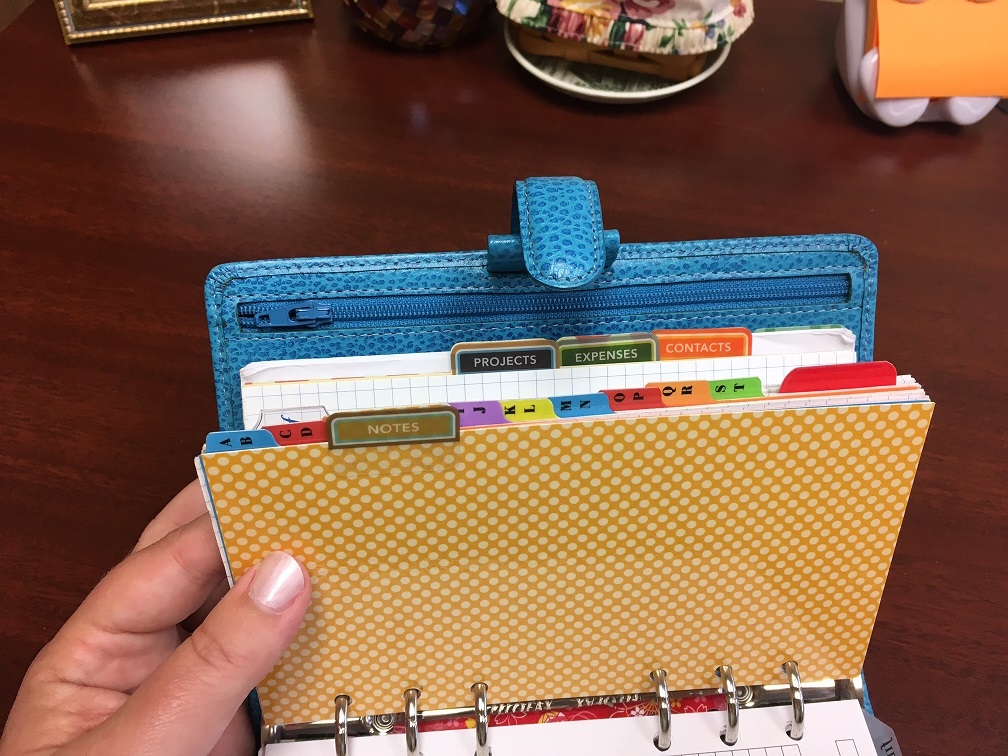
I think my little Filo is perfect. They thought of everything: calendar and address book, a pocket for cash, a small zipper section for change, slats for credit and business cards in the front and place for a pencil that is beneath the strap that snaps shut.

7. What was the last movie you watched? 

Challengers..the tennis movie. I loved it!

9. What was the last book you read? 

The autobiography of Isabella Stewart Gardner

10. When did you start using an organiser? 

It's hard to remember! But, I think it was 1997

11. How has your use of an organiser changed over the years? 

Yes, it has. I have used it as a general calendar so I can see a week and a month at a time. It is hard to pretend the phone calendar doesn't exist b/c so many events come with ready links to the calendar. It's easier to accept them. However, after abandoning the Filofax for a number of years I have rekindled my love for it's straightforward, no nonsense information organization. It makes me feel less anxious to see the week at at glance with all the info I need in one place and not on a tiny screen. 

12. Which diary format works best for you and why? 

Week at a glance. I need to see what I have each day at once so that I won't miss anything.

13. What other information do you keep and maintain in your organiser? 

I have phone numbers of importance: family, friends, stores. I love the month at a glance to keep things in perspective. My Filofax also has a wallet and change purse in it, which is handy despite the reality I rarely use cash!

14. What routines and structures do you use? 

I have found that I can carry my Filofax with me and my phone in my purse. I use a pencil to keep daily dates in my Filofax and at night I transcribe the events that are on my phone. I find that this system works for me to not miss appointments b/c I am looking at my whole schedule at night for the next day. 

I fell out of the habit of keeping a written schedule for a bunch of years and eventually, lately, I realized I was missing events and appointments b/c I wasn't seeing my weekly schedule and only relying on the alerts from my phone and those weren't obvious enough...so I missed things. 

15. Do you use one binder or several, and if several, how do you use them? 

I used to use two,  many years ago when I was decorating and I had one for my wedding too! 

16. Tell us about your You Tube channel 

My channel is connected to my Blog, Women's Survival Guide. It hosts the women I interview and small videos I do on an array of subjects like my Filofax! www.womenssurvivalguide.com

Thank you Kim.

If you would like to take part in this series please email steve@philofaxy.com and mark your email 'Experienced Filofax User'

22 September 2019

Experienced User - Andrew

This week we will see how Andrew uses his organisers. 

My name is Andrew Coleman. I'm in my late 50s and live in Brighton, England. I work as a  Senior Lecturer at the University of Brighton and as a (town) planning and environmental consultant.

I'm also a Regional Rep for the environmental charity Surfers Against Sewage.

1. When did you start using an organiser?

I bought my first own-brand organiser from WH Smith in the late1980s when Filofax underwent a yuppie revival - and had the p*** taken out of me remorselessly by my colleagues in the public sector!

That one was replaced in the 1990s by a black Personal Buckingham. However, I was aware of them as we had some earlier ones at home - my grandfather had one during the First World War, according to my mother.

2. How has your use of an organiser changed over the years?

It has waxed and waned although increased over the last 10 years as my work and personal life has become more complicated with a 'portfolio' career, a spouse who works internationally and a daughter who has her own developing social life.

I struggle to maintain synced digital calendars on various work software packages and my Filofax is the place I sync them.

3. Which diary format works best for you and why?

I use 2 weeks to view as I find they get too heavy otherwise.

4. What other information do you keep and maintain in your organiser.

I have contact details and info I need to refer to frequently about work and my other interests (including a Fulham FC fixture list).

5. Do you use a 'system' of organisation, and how does it work in your Filofax?

I have a ruler/place-marker and a single sheet 'to do' list that I move forward through the diary and update every fortnight.

I aspire to using different coloured ink pens or highlighters to categorise the diary entries and to do items but haven't found a way of doing it easily (the multi-coloured Bic biros are too big for the pen loops). Other info is in the back.

6. What routines and structures do you use?

See above

7. Do you use one binder or several, and if several, how do you use them?

I'm now also using a slimline leather personal (which looked like it was supposed to be clipped into a bigger one) for holidays and a 'vintage' Microfile as a library for the diary I keep of holiday trips.

I'm toying with the idea of having a bespoke cover made by a local leather workshop which should last the rest of my life and be nice to hand on.

In the meantime, I've bought a secondhand Hamilton as I fancy a brown organiser.

Thank you Andrew. 

If you would like to take part in this series please email steve@philofaxy.com and mark your email 'Experienced Filofax User'

15 September 2019

Experienced User - Dot

This week we will see how Dot uses her organisers. 

1. When did you start using an organiser?

I have used a diary/planner all my adult life, usually buying an annual diary from stationery stores. However, when I went to university as a ‘mature student’ to become professionally qualified as a youth worker in 2006 I needed something considerably more flexible, which allowed room for me to manage my time efficiently.

I was still working 30 hours per week, was a single mother to two teenagers and attending university full time. I needed to track my daughter’s schedules - both social and educational - assignment due dates, work planning deadlines and a very tiny personal life, and eventually placement schedules.

My first Filofax was a Finsbury A5 which is still in use today as a ‘home organiser' keeping my family's health records, car insurance, household insurance, useful blog sites and all manner of useful info in one place.

2. How has your use of an organiser changed over the years?

I found using a Filofax so invaluable, I became a firm fan and have bought five more Finsbury binders. One A4, two personal size and two pocket size.

I have used a pocket Finsbury as my wallet for almost five years. I get many questions and compliments when using it. It has card holders with my bank and store loyalty cards at the front and note pages at the back of the card holders, which I add to throughout the week to build up a food shopping list. I use a mini PaperMate inkjet gel pen in the pen loop as I found the Filofax pen kept falling out of the loop. I do find using the zipper pocket for coins can be awkward so I regularly empty them out because of this. The large pocket at the back is excellent and can hold notes as well as receipts.


For my daily scheduling I use an ochre coloured Malden. I started with an A5 Malden with Filofax business pages but this wasn’t always a convenient size for me, it was too big and bulky to carry. I also found the leather of the A5 Malden felt hard and not soft, at all, so I briefly used a Midori Traveller note book which is beautiful soft leather but the books didn’t quite suit my needs and so I switched back to my A5 mid-year.

This was when I bought the personal sized Malden (also in ochre) and the leather on that one is much softer and ‘buttery' as is so often described by other users. I love this one more than any other planner I’ve used and this has been my every day companion since, both for professional and personal use.


I now use the Midori as a notebook in meetings where space to write is limited, and the A4 Finsbury I use to carry files/case notes for meetings and carry additional note paper to make notes if necessary. I don’t need to use the A4 every day but when I do it’s also an excellent writing surface to use.

3. Which diary format works best for you and why?

I have recently bought the Daytimer original WOTP format. I prefer to use an academic diary which suits the ebb and flow of my work. Although a recent purchase, I have quickly found the page layout is perfect for me and I love the monthly dividers which include additional note pages which are headed “To be done in.....” month page, this is very useful to me.


I'm a list maker, and this has helped me easily track monthly deadlines at a glance. I don’t decorate my pages as such but I do use stickers to highlight particular types of appointments, holidays and key events. I find the Carpe Diem ones very useful, but have bought others from Etsy and stationery stores.

This is the first time I’ve used Daytimer and the quality of the paper is good, I think I will probably stay with them.

4. What other information do you keep and maintain in your organiser.

I keep a page with all important anniversary and birthdays. I have to regularly visit certain places to attend meetings so I maintain a sheet with addresses and post codes to make claiming expenses quicker and simpler.

I also keep a sheet with key information on for business use. These information pages are kept updated and are permanently left in my planner.

I also keep Christmas planner pages, which is just note paper that I add gift ideas and draw up the food list. We always go away just before Christmas so I have to be organised for the festivities by the end of November so when we return I simply have to organise the fresh food.

5. Do you use a 'system' of organisation, and how does it work in your Filofax?

I have three sections in my personal Malden the first section has zipper pockets where I carry my stickers, post it notes and paperclips.

The second section has zipper pockets for receipts for claiming expenses and where work related information sheets are kept.

The third section is the diary and includes the anniversaries, key dates and Christmas list sheets. The section dividers I made myself from pretty card folders I bought from TKMaxx and laminated.

I bought the recommended 6 hole punch years ago and have always made my own dividers as these are more personal than the business like Filofax.

6. What routines and structures do you use?

I check my diary daily and at the start of every week, I ensure I am organised for the meetings I will be attending.

As the Daytimer sheets have two columns for each day I use one side for reminders and one for appointments.

Using stickers to highlight particular types of appointments adds personality as well as functionality for me. A quick scan and I know where I am with meetings etc.

7. Do you use one binder or several, and if several, how do you use them?

As explained earlier I use several binders but only use two every day. I also bought a beautiful A5 Chameleon in spring green off Ebay a few years ago and used this as my summer planner at work because of its gorgeous pale colour but wanted to keep it in good condition so went back to my A5 Malden, which looks better for getting a little knocked about.

However once I bought the personal Malden and felt the soft leather I’ve ‘made' personal size work for me professionally and personally. I get as much pleasure from holding and touching the binder as I do using it.

My family think I am a bit potty for being so ‘into’ planners but for me it’s the practical uses that help to keep my stress levels down. My job is demanding and can be emotionally draining with timescales and deadlines that have to be met.

By ensuring everything goes in my planner and any additional info can simply be added on note paper and fitted between the weekly spread, I can keep track of everything and remain on top of my workload and not miss important family events too.

Thank you Dot. 

If you would like to take part in this series please email steve@philofaxy.com and mark your email 'Experienced Filofax User'

01 September 2019

Experienced User - Graham

This week we will see how Graham uses his organisers. 

Hi, I’m Graham, a self-employed data consultant and author currently based in Germany.

1. When did you start using an organiser?

Back in the early 1980s when I was at University and when Filofax became the accessory for yuppies and those pretending to be yuppies.

In those days when computers weren’t portable, it was an indispensable way of storing and carrying information – a real file of facts.

2. How has your use of an organiser changed over the years?

As with most of us, the amount of data I need to deal with is increasing all the time, and with the availability of different media for storing and processing that data, my organiser is now only part of my personal data management process.

As I’m a data consultant, how I deal with my own data has extra resonance (and is always of interest to my clients). I stopped using a paper organiser with the advent of the (much missed) Palm Pilot in the late 1990s, the simplicity of which made it a great replacement for a paper-based system. But as portable devices became more complex, often in unnecessary ways, I found that I was far more efficient for some parts of the process when working from paper.

 I moved back to a paper-based diary about 15 years ago. So now I have parts of my system on a PC, some on a mobile telephone, and some in an organiser.

3. Which diary format works best for you and why?

I use a dual A5/A7 system. The A5 (Filofax Heritage) is large enough for my business and personal needs and I use a self-designed one week on two pages layout.


The days are all on the right-hand page (because I am right-handed and writing across rings is one of those things that drives me potty), all equally sized (because I am self-employed and don’t have “weekends” when less happens).

On the opposite side there’s space for recording dated todos, time use and multi-day events – this works for me in the Heritage because of the small rings. You can get a better idea from my YouTube channel.

However, I don’t like carrying around an A5 organiser – it’s too big and too heavy. So I have a mirrored system in a Filofax pocket slim Lockwood which I can slip into my pocket when I’m away from my desk. That’s also explained on my YouTube channel.

4. What other information do you keep and maintain in your organiser.

I only store appointments and dated todos in my organiser. Apart from a Filofax A5 Lockwood and some Filofax notebooks with some project-specific notes, almost everything else has found a place (digitally) elsewhere.

5. Do you use a 'system' of organisation, and how does it work in your Filofax?

No. I’ve read about various systems, such as Getting Things Done and the Bullet Journal method and, when I break them down into what they are actually proposing, it’s basically what I naturally already do. I’m already ridiculously efficient, to the point of ennui – trying to be more so would be futile …

6. What routines and structures do you use?

I wouldn’t call them routines, but there are some things that do occur in the course of a day or week – I transfer recurring appointments sometime once per week to the new week and I write the next day’s appointments and tasks on a special A7 page before the end of the day before so that I can refer to it as required when on the move. And, around October each year, I assess my current layout, make tweaks, update my spreadsheets for the next year, and print the next year’s diary pages.

7. Do you use one binder or several, and if several, how do you use them?

I have several. I can’t seem to get on with only one. I recently tried moving my diary to the A5 Lockwood which contains my project-specific notes,  but that just meant more to carry in a heavier package, and, with the larger rings, not being able to write on the left-hand pages. I gave that up as a bad job after two days.

Equally, I wouldn’t want to be carrying around my project notes when I only want to take a diary with me to make an appointment. I’m a great believer in using the best tools for each job, and for me that’s always meant storing data in many different places, including several different organisers.

Thank you Graham. 

If you would like to take part in this series please email steve@philofaxy.com and mark your email 'Experienced Filofax User'

18 August 2019

Experienced User - Franz

This week I would like to thank Franz for sharing with us how he uses his organisers.


My name is Franz Schimmelpfennig, 72, based near Saarbrücken in the Southwest of Deutschland, close to the French border (10 min. walk), not far from Luxemburg.

I spent my professional life in IT, started as a programmer working with punchcards up to being an IT Executive in an international US company in modern times: I’VE SEEN IT ALL!

When did I start using an organiser…I mean, everybody had a sort of note taking book/block (this was in the 70s!). Then, in 1986, my employer sent all staff to a Time/System training - T/S was supposedly the leading system in Europe. They were based in Denmark, I believe.

I remember very well the introductory sentence: „…today is the first day of the rest of your life…you better get organised in order to make the best use of your time“. It was quite revealing - a new view on time!

So, I invested in a nice leather organiser with a zipper and went on from there. Standard was A5 six rings - smaller formats came later.

I was a happy camper with my T/S - on the left side, there was a folded double page which kept the to dos; on the right, I had one page per day. At the end of the day, you would turn the day and hide it under the flap of the folded double page. At the end of the week, you would take the package out and store it in a box (and bin it - until today, I never go back to old timer records).

How has your use of an organiser changed over the years?

My organiser story is not different than that of many users that I’ve seen or read about:
  •     Paper
  •     Ringbook organiser
  •     Palm Pilot :-D all versions
  •     Psion (just because it was so cool)
  •     Compaq Handheld
  •     iPhones galore
BUT: I never gave up my ringbook. Writing something down / scribbling / drawing is so much more human nature…

Which diary format works best for you and why?

For many years, I was happy with my T/S until I got in touch with Franklin Quest. At that time, I was working in an international team and one of them had a Franklin Quest organiser. What I found intriguing was that FQ had a layout opposite to my T/S: the to dos on the RIGHT hand side and the day on the left. How much easier for a right-handed guy to keep track of the to dos rather than scribbling on the left page with the rings in the way!

So, I retired T/S and got my a FQ in classic Format (A5 like).

Some time later, I went to work in the US for a couple of years (early 90s). At that time, every upscale mall had a Franklin Quest shop with bookshelves full of binders in all sizes and leathers, papers, books, dividers, stationery related to FQ - it was haptic nirvana!

Over time, I went through many versions of FQ: classic, monarq (A4 like), Standard (teal) inserts, Monticello inserts; my monarq size book with the Monticello inserts looked quite impressive!

In 2000, I came back and worked in our Paris office for several years. What FQ in the US was Filofax in Europe: every decent warehouse had its Filo corner and in Paris, there was even a Filofax store!
Coming from T/S and FQ, I switched to Filo A5 (same Format and rings as the old T/S).

In the last couple of years, paper got less and less important - all the necessary information is on an electronic device: I tried to scale paper down.

One day, I detected the „Loehn“ method: Loehn is an engineer (professor) who developped his own method based on the  Grossmann method (developped in the 1930s!) very close to today’s GTD.
Loehn provides hardware in A6 Format and the paperwork that goes with it. Similar methods are Helfrecht (Germany) and Hirth (Switzerland).

A6 comes very handy since it fits in one’s pocket.

I’ve also tried to scale down to Filo Personal but I usually drop it after a couple of weeks because of the size: too thick/too big for a jacket - not much more writing space than my A6…
Inserts:

For my A6: Filo week on one page with notes, trimmed to 87x150mm.


For my Filo Personal: Exatime Étroit papier ivoire (yellow) 170x92mm, semaine sur 2 pages.


Currently, I keep calendars and project/information pages in both A6 and Filo Personal format for easy switching because I keep coming back: my Filo story is an on/off story - I really love Filo just for the Britishness and the venerable history. (regarding Britishness: I just had my 20 year old umbrella repaired by Swayne, Adeney, Brigg in London).

Now, retired, I play with different formats according to the occasion: day-to-day: A6, recently on travelling (vacation): Filo Kensington (it fits into the side pocket of my Fjällräven trousers!) with printed maps and paperwork, for more official use (club, authority): I put my A6 into my Filo A5 (zipped) for leaving an impression 🤓.


I also use a Finsbury slimline in black and a Holborn compact in red on occasion.

How has your use of an organiser changed over the years?

In the early days, everything went in - today, it holds only
  • calendars (Filo: week per page with notes; for my A6 book, I cut the Filo Papers to 87x150 mm and Punch new holes), 
  • projects 
Informations which I find useful for quick reference:
  • air pressure for the different tyres of the household (car, 5 bicyles, trailers), 
  • European countries with numbers, 
  • historic numbers, 
  • family gift list, 
  • checklist of my method (for occasional review and tuning), 
  • note papers for shopping / observations, 
  • checklist for emergency routines (what to pack: documents, stuff), 
  • emergency phone list, 
  • household procedures (for occasional review/tuning)
  • personal information.
Everything else is electronic (iCloud).

My method has developed over the years and is - naturally - close to GTD. My paper organiser is set up accordingly:
  • inbox: 
    • for paper, I use an A4 desk folder which I process in the morning
    • email. my mail tends to be empty since I usually process every entry asap.
  • calendar: 6 months of week per page with notes + monthly overviews
  • Projects: the daily nitty-gritty stuff; milestones are on the PC (I use „Agenda“ on my Macs). I do a daily review - new to dos go on the „notes“ page of the week.
  • Information as mentioned above.
Rule: there is only one calendar/agenda for a person! No split into private/professional life.

I don’t keep money (bills, change), stationery, stamps etc any more like I did 10 years ago :-D

No credit cards either - ApplePay and the likes make it obsolete.

Recently, I was travelling in Estonia and Sweden - completely cashless! A new experience…

And - I don’t decorate my planners (and no family pictures - they are on the mobile phone).

Best regards,
Franz

Thank you Franz, 

If you would like to take part in this series please email steve@philofaxy.com and mark your email 'Experienced Filofax User'

11 February 2018

Experienced User - Kendra

This week I would like to thank Kendra for sharing with us how she uses her organisers.

Hi! I'm Kendra. I'm a CFO and owner of a property management company in Southern California, and I spend a lot of time volunteering for the local and national apartment associations.

The time I have left over is occupied with sewing, knitting, photography, DJing, dancing...and, of course, using my planners to keep it all straight!

You can follow my planning adventures on Instagram  or on YouTube, where I post videos on functional planning.

1. When did you start using an organiser?

I've always loved organizers. Initially I used a Franklin Covey planner and system, then switched to mainly digital planning when we started our company in 2006.

In 2015, I rediscovered paper planners when I bought an Erin Condren spiral-bound planner and haven't looked back since. I now merge digital and analog so that it works for me, but my planning is mainly done on paper as I feel as if I think better when I'm putting my thoughts down with pen and paper.

2. How has your use of an organiser changed over the years?

I just used the calendar portion of the organizer for many years. Reading Getting Things Done by David Allen fairly soon after graduating from college opened my eyes to tracking tasks and a more finessed version of project planning.

In the last couple of years, I've become more interested in planning and goal setting based on my core values and my job description (mainly for work).

3. Which diary format works best for you and why?

In my personal/home planner I used a daily page format that I created myself with a month spread as reference for major events.


For work, I recently switched to a bullet journal system. Previously, I found myself either wasting a page when I had mostly meetings or was traveling for work...or running out of room when I had a busy day and a lot of things to do.

The bullet journal solved that problem for me; I just pick up wherever I left off when I start the next day's schedule and task list.


I do keep work and personal separate as I prefer not to think about work when I'm at home, so I just leave the bullet journal at the office. (This was a hard-won battle as a business owner, but I'm much less stressed when I follow my rule.)

4. What other information do you keep and maintain in your organiser.

My personal/home planner sections are:
  • goals (vision board, master goals list, individual goals broken down)
  • calendar (monthly and daily pages)
  • to dos (tasks broken down by personal tasks and house tasks)
  • youtube (list of video ideas, video planning pages)
  • lists (current workout schedule, books to read, series/movies to watch, budget template, phone list for the office staff, pets insert). I also have a travel section for an upcoming trip, but that will be removed when the trip is over.
I also use a Momentum Planner for goal setting and project planning, which as it is letter sized, resides in its own disc-bound system.

5. Do you use a 'system' of organisation, and how does it work in your Filofax?

For my personal planner, I use a combination of Getting Things Done for tasks, and Flylady for home routines. For my work planner, I use the bullet journal method.

For both, I use a modified Strikethru method for tracking tasks because I like the reference system (page number-dot-item number).

In the ring binder, they are loose-leaf pages that are numbered. In the bullet journal, I started the task list pages from the back of the notebook.

6. What routines and structures do you use?

I have daily and weekly routine tasks that form the structure or "hardscape" of my days. My house is broken down into zones for cleaning tasks or decluttering, the latter of which is one of my goals for the year.

I also have lists for periodic reviews of what I have going on as well as my planner and its contents so that everything stays up to date.

7. Do you use one binder or several, and if several, how do you use them?

While I have many different binders and traveler's notebook covers that I have collected over the years, I have one main binder for my personal planning that I adore and use constantly, a custom Van Der Spek in Tortora croco and barbie nappa.

For work, I use an emerald Leuchtturm1917 notebook.


My favorite TN covers are from Chic Sparrow, especially the Outlander Time Traveler, which is a lovely deep blue.

When I get the urge to use a traveler's notebook, this is the one I reach for. In fact, I love it so much, I bought it in both pocket and personal sizes.


Thank you Kendra,

If you would like to take part in this series please email steve@philofaxy.com and mark your email 'Experienced Filofax User'

15 January 2017

Experience User - Maria

This week I would like to thank Maria for sharing with us how she uses her organisers. My name is Maria. I am a 39 year old librarian from Denmark.

1: When did you start using a organiser?

For many years I used the kind of spiralbound calendars you would get for free, but in 2007 I started using a Filofax.

2: How has your use of an organiser changed over the years?

I used to only record a couple of things: homework/working hours, a few to-dos and small notes if something special happened.

From 2007-2011 I used my mini Lyndhurst, always with a week per view or week per page. I carried a whole year of inserts and I only used my Filofax for my private life and just noting down my work schedule.

In 2012 I bought a plastic Hello! Project organiser in pocket size, and from them on I started exploring the Filofax world, including different sizes, systems and diary formats. … and of course multipens, sticky notes, washi, you name it.

I used my Nokia E71 for work to-dos, but as my work became more complex, keeping my work to-dos in my phone became too crowded and I started using my Filofax for work as well.

3: Which diary format works best for you and why?

After I combined my work and private life in my Filofax I found daily pages works best for me. I only use daily pages with a timetable. I block out meetings and appointments on the left side of the page for a better overview of how much time I have for my to-dos. On the right side of the page I write my to dos. I also use monthly pages, but I have a special use for them.


4: What other information do you keep and maintain in your organiser?

I use Filofax month on two pages as a record of the year. I write down my actual working hours to the left and any events I want to remember in the little squares. I have to use a 0.3 to write in the monthly pages, 0.4 is too big. I only keep these monthly pages as I trash my daily pages after a month.


I also keep my health tracker, a few pages with work info, my goals, my yearly tracker and my zone-cleaning schedule in my Filofax. I draw out my trackers on pocket sized 3 mm squared paper I have cut down to mini size.

5: Do you use a 'system' of organisation, and how does it work in your Filofax?

After discovering DIYfish I have been using the same system with minor tweaks. I print my DIYfish simple daily layout v5s3 at 85 % on 70gsm paper and it fits perfectly in my mini. I use a Hi Tec C Slims and write down work in black, private in red. Completed to-do is crossed out in black, transferred to-do in red.

I only keep 3 months of daily pages in my Filofax. For future planning I either use DIYfish monthly foldout pages or post-its on a dashboard. For long time planning I use a DIYfish resized One Year Calendar A6 where I write birthdays, holidays and to-do only occurring once or twice per year. It doesn't matter if I am in a pocket or a mini, it is the same system I am using.

6: What routines and structures do you use?

Every night I write :) or :( in my health tracker. Saturday or Sunday I prepare for the next week.


7: Do you use one binder or several, and if several, how do you use them?

I only use one at a time, but I own many. I have several favourites: my Pocket Luxe Ebony and my Ochre Maldens in mini and pocket, but for a long time – it is all relative, but 7 months is a long time for me – I have been using a mini. Most of the time I have been using my Guildford Extra Slim. I find that if I am not using my Filofax enough, changing the binder helps weeding out unnecessary stuff and making a fresh start.

Thank you Maria,

If you would like to take part in this series please email steve@philofaxy.com and mark your email 'Experienced Filofax User'

23 October 2016

Experienced User - Michele


This week I would like to welcome Michele to share with us how she uses her organisers.


Hi All, I'm Michele,  and I live in New York  with my fiance, our cat and dog with my son away at college.  Presently, I am an  independent project management contractor which progressed from my work in the marketing within the information technology industry.  

Between assignments I stay very active in the project management community by volunteering with our local chapter of the Project Management Institute (PMI).  

1. When did you start using an organiser?

It was between 1990-1992.  I was very lucky in those days when Filofax was so popular as the "must have" accessory.  Located next to my Manhattan office was a business supply store filled with everything Filofax!  

Then Filofax opened a retail store within my local shopping mall.  I thought Filofax was used mostly by male executives until I read in Madmoiselle that Lori Laughlin of Full House used one.  As soon as I read the article  I rushed to the store next to my office and bought a green pocket Kensington.

2. How has your use of an organiser changed over the years?

In the early years thru 1996 I barely kept it beyond keeping track of appointments and maintenance work on my car.  I moved away from the Filofax once I was home with a baby and used an organizer his pediatrican gave me. Needless to say, my Filofax spent a lot of time stuffed in the drawer.  

In 1996 I became a single mom and that is when I REALLY got serious about my organizer.  I lived alone with my two-year old, and I had to manage a household budget so I would be comfortable paying rent.   I pulled my organizer out of the drawer, and it has never seen a drawer since.  For budgeting finances which I was most nervous about I designed a monthly budget template which I still use today.  

I  record every expenditure in designated categories -- every penny is tracked!.  At the end of the year I do a full tally up and set up budget goals for the upcoming year.  I feel so strongly about these budget sheets that I still maintain them in my archives going back to 1999. 


All my business contacts, meetings and hours spent on contract jobs are noted in my organizer.  I do find using a notebook for work  helps me with my job rather than a ringed binder (which I tried for a year, but I wasn't comfortable using).  

What has evolved is how I use those printed "To Do" pages that come with calendar refills.  I just don't even try to use them anymore.  I have found I need those To-Do's need to be on the day itself or on a "Project Page"

3. Which diary format works best for you and why?

I prefer Week on 2 Pages format as it allows me an overview of the entire week at once.  I do love the monthly overview, but I cannot imagine adding more to my format. 

In 2011 I purchased the Filofax Business 1 Day per Page for the separate work binder I had then, but I did not use it to its full capacity.  This year  for the second time in my organising life I started using 1 Day per Page with Life is Crafted daily inserts.   These inserts are a great organising tool, however I miss my Week on 2 Pages.  

Earlier this summer I purchased on sale July-Dec A5 Week on 2 Pages from Life is Crafted for my new A5 Van der Spek.  I'm totally in love with this layout because in addition to  the vertical view of the week, there's plenty of room to write down tasks, goals, tracking, etc.   

For 2017, I'm going to buy Life is Crafted Week on 2 Pages for both my Personal and my A5. The layouts are completely different, and I think I can have one to "organising" and one for "planning".  I got this idea from Mella's YouTube  Planning vs. Organising video.   


4. What other information do you keep and maintain in your organiser. 
  • My mother's online information.  She is now 87, and she is an avid iPad user.  I have to be ready when I receive emergency calls when she's forgotten a password.
  • My passwords all in code
  • Job Positions I have applied for are written down on the day I apply.  
  • Exercise and weight tracking
  • Project lists for house, vacations, etc.
  • License plate spotting from road trips 
  • Vision board for future events such as my wedding planned for sometime in 2017
5. Do you use a 'system' of organisation, and how does it work in your Filofax? 

I never got into  Getting Things Done or Bullet Journaling.   My "system" is how my organiser is set up consistently year-to-year.  

6. What routines and structures do you use?

I keep track all  of my "meals out" expenditures and my daily weight recording.   Every $ I spend is recorded immediately or I keep the receipt in my wallet until I write it down. I go over what my daily goals and tasks are for the day.  Whatever wasn't important enough to achieve that day is carried over to the next day.

7. Do you use one binder or several, and if several, how do you use them?

Standard Van der Spek is my go to all in one book.  I put everything in here, and it's always next to me to record errands, job applications, meetings, weight, goals, daily tasks $, etc.

A5 Van der Spek started this year as mainly a vision board of photos for future life events and a record of our recent house makeover. By adding the July-Dec  2016 inserts the A5 mirrors the Standard.  I will definately purchase the full year for 2017 inserts as it is such a detailed calendar for the week on two pages.  

Mini Van der Spek is used primarily on the weekends as a wallet or when we are away on a trip.  It's perfect for stuffing currency in the side pockets, a few cards, etc.  I use the calendar for license spotting and for my exercise diary. 

A5 Mustard Finchley is very sentimental and is used for Christmas and holds many sentimental professional notes I've taken over the years.  

Thank you Michele,

If you would like to take part in this series please email steve@philofaxy.com and mark your email 'Experienced Filofax User'

11 September 2016

Experienced User - Rebecca

This week I would like to welcome Rebecca to share with us how she uses her organisers. 

Hi there!  My name is Rebecca Bover and I am a Planner Addict.  I am also known as One Fantastic Find! on YouTube.

I was a Technology Trainer for years, now a Project Manager - so I've always been the kind to share anything...

1. When did you start using an organiser?

I've always used one....for as long as I can remember but it was almost always a DayRunner or a Franklin Covey.  The first Filofax I purchased was a personal sized Crimson Malden from a local stationery shop here in Indian Wells, CA.  I bought it not realizing how sought after they were.  The next one I purchased was an A5 Raspberry Finsbury to be used specifically for work as I had recently become a Project Manager and thought I would need more space than a personal size could provide.  

2. How has your use of an organiser changed over the years?

It has changed immensely over the last few years.  I originally began using the A5 Time Management insert set in the Weekly view for work because they also came with project management pages, a section for expenses, notes, and more.  I loved them.  You can see a video here: For the love of Filofax: A5 Filofax Business Setup Update

However,  the one thing that I always longed for was the convenience of having everything in one planner and the portability to carry it with me wherever I went.  That's when I was introduced to the DIYFish inserts.  They have been a staple of my planning over the last few years.  The brilliance of these inserts are the ability to see your month, week, and day all in one view and that was exactly what I wanted.  I thrived on these inserts.  

3. Which diary format works best for you and why?

Originally, the weekly format is what worked best for me, but over the years I moved to a daily view.  Mostly to keep me grounded to what has to be done each day. 


In May, I moved from my Gillio medium Campagna in Red to the bound planner made by Hobonichi.  


It is currently held in a Van der Spek custom cover I had made.  Isn't it lovely? 


If I could find a planner that could show my weekly schedule (varying times for appointments) in view at all times and have a daily view to jot my to do's and chores (some recurring, some needed to be done on a specific day) also in view then I would truly be in heaven.  I hate flipping from one section to another.  If I don't see it, I won't use it.

4. What other information do you keep and maintain in your organiser. 

I have an annual vertical calendar that I track my husband's schedule, my firm holidays and my vacation and sick days.  My Monthly calendar is used primarily to track bills, birthdays and holidays which I then refer to on my daily pages.  

5. Do you use a 'system' of organisation, and how does it work in your Filofax? 

I don't really think I have a system, more of a routine then anything.  Repetition is my friend as far as keeping me on track.  I do use my own system when it comes to home maintenance to keep up with daily, weekly, monthly quarterly and annual household needs.  I keep these in a separate notebook which I then can carry from planner to planner, year after year - regardless of how my planning evolves.

6. What routines and structures do you use?

I have a laminated card that has repeating daily and a few weekly tasks on it that I then use a wet erase marker to tick off when they are done.  


At the end of the week, I simply use an alcohol swab to wipe it clean for the next week.  I am going to make another one, but this time add a meal planner on the back side so I can plan out my week's meals and reuse it.  Right now, I am winging it when it comes to meal planning and that isn't always convenient when I forget to defrost the meat I want to use.  As stated before, I also use my home maintenance notebook to refer to monthly tasks that should be done.  I also have a perpetual calendar for birthday's and holidays that I refer to each month to make sure no one gets missed.

7. Do you use one binder or several, and if several, how do you use them?

Right now, I have two going on.  A Hobonichi Planner (A6 size in English) for my everyday carry and a Filofax Original (personal size in Pear) that I am using as a Holiday Planner in preparation for Thanksgiving and Christmas.  It holds meal plans, gift giving ideas, budgets, purchases, holiday decorating supplies, visitors, cards, receipts, etc.


Thank you Rebecca,

If you would like to take part in this series please email steve@philofaxy.com and mark your email 'Experienced Filofax User'

31 July 2016

Experienced User - April

This week I would like to welcome April to share with us how she uses her organisers.


I’m April Robinson, living in Michigan with my husband and our cats (rescues all.)  I work full-time as an accounting clerk and office manager.  My hobbies include reading, music, sewing, crochet, and gardening. 

1. When did you start using an organiser?

My first planner was a hardcover-over-spiral week-on-two-pages formatted calendar called the Administrator, circa 1993-94.  It wound up becoming a vital part of my recordkeeping (I was a new wife starting out in my own household), but I grew out of it. In 1995, I acquired my first ring-bound organizer, a Franklin Compact size with a leather and cloth (tapestry) cover.

2. How has your use of an organiser changed over the years?

I’ve been really consistent in the bones of my planner usage.  Franklin-Covey’s system of listing and prioritizing tasks with a separate column for appointments was a model that still makes the most sense to me, 20+ years later. Daily pages in a personal size has been my most frequent format, but in previous jobs, I’ve needed an A5 or even (in Franklin-speak) a Monarch-size.  

The latter two I used in a week on two pages format. Now that I’m only responsible for tracking my own work and appointments, the personal size is fine. But regardless of size, I’ve always used monthly pages, then weekly or daily (sometimes two pages per day.)  

Once I had discovered Franklin, I was permanently in love with ring-bound planners. I eventually took to Filofax by about 2002, after a stray catalog came my way.  I loved the variety of binders, page sizes, and, back in the day, all that variety of pre-printed forms.  

However, I did depart for a few years into the disc-bound world of Levenger’s Circa system.  I found it sleek and elegant and especially stuck with it for the superior paper quality (I’m a diehard fountain pen user.) Eventually though, I missed the ease of moving things around in a ring-bound system.  Looseleaf pages of the disc-bound system get hung up on each other, and those edges do fray after several cycles of moving around.  

By the time I was ready to leave Circa, Filofax had my heart once again…except for that thin paper quality!  Thankfully, I found Philofaxy and learned of customizable inserts I could order or print myself.

3. Which diary format works best for you and why?

Currently, a detailed page per day in personal size is ideal.  For 2016, I attempted my own design for the first time.  Working off of Ray Blake’s generously provided files and his excellent instructions, I created a page that truly works for me and pleases me aesthetically as well (pictures attached.)  I will never have more appointments than I have tasks, so I made a smaller, general area for including those or for other noteworthy events such as important visitors at work, or special event or outing.

Below that are two columns for to-do’s, separated by office work or things for home and personal.  I also wanted to prioritize areas of creativity (I quilt, crochet and write) and study (Bible study and foreign languages.)  And finally, I track my water consumption and supplements. 


My monthly pages are for tracking travel (hubby’s as well), due dates, my vacation time, and appointments.  I’m currently loving the tabbed monthly pages from Handy Forms.  I must have lines in my calendar boxes, and the paper is wonderfully sturdy too. 


If I decide for 2017 to dispense with the homemade inserts, I’ll likely go back to DIY Fish, which I found to be exceptionally well done.

4. What other information do you keep and maintain in your organiser.

As I’ve had for many years regardless of planner system, I maintain tabs for Notes (subdivided by categories of info), Contacts and Projects. 


In front, I continue to retain Filofax’s pages showing international holidays (useful at work), and a year-at-a-glance foldout insert for the following year.  In a plastic sleeve atop all, I keep my basic information page.

I created a copy of the Filofax version of the “Personal Information” page in Excel, and print new ones as edits require.  I’ve found it invaluable to have some of this data with me at all times.  (I’ve heard of folks having concerns over personal information in their planner in case of theft.  But I don’t have any credit card, social security or financial information included.

My address, anyone could get online these days regardless, and the insurance policy details are harmless.  However when I’ve misplaced my planner, including one grim day when I distractedly drove off and it flew from the roof of my car, having my contact information right in front made it possible to recover my planner quickly.)

5. Do you use a 'system' of organisation, and how does it work in your Filofax?

I’ve probably already stomped over this ground in my answers above.  But again, Franklin Covey’s method is tried and true for me and works seamlessly in my Filofax.  Beyond that, I do like the DIY Fish system, though am not currently using.

6. What routines and structures do you use?

I find a bit of inspiration in the old “Seven Habits of Highly Effective People” approach.  Other than that, my only structured routine involves caring for my home, and I use the Flylady system.

7. Do you use one binder or several, and if several, how do you use them?

I use only one binder for planning at the moment.  But I am likely going to appropriate one of my A5’s for a second planner, storing information I’m not likely to need when out and about…certain sections in my Notes area.

This would include things like lists of movies, books or TV shows I’m interested in, home maintenance activity, areas of research I need to pursue, things I need to sell on eBay, and so on.  This will thin out my “everyday carry” nicely.  But I will retain sections relating to my cats’ health, bills, an ongoing grocery list, and communication log in my EDC.

Other A5 binders are in use for garden planning and info, quilt patterns and fabric swatches, and I’m about to create another organizer for crochet patterns and yarn samples.  A fourth is dedicated to Bible study.  I’m in the process of converting my language study notes into a Travelers Notebook format, which will free up another A5.  One tip: the $20 I spent to get two reams of A5 paper into my possession have been more than worth it.  (Thanks, Amazon!)

Thank you April. You can catch up with April on Instagram @scribbles_and_bits

If you would like to take part in this series please email steve@philofaxy.com and mark your email 'Experienced Filofax User'

25 July 2016

Guest Post - "Experienced User" can learn a thing or two - Carla

Hi, Carla here.  About a year ago, I was featured as an Experienced User.  Life has changed – AGAIN.  This ‘experienced user’ has learned a thing or two.

Lesson #1) being that a photographer, I am not.  So we’ll talk.  Warning, this will be long.

Lesson #2) find your system, then nothing short of your planner drowning or meeting a fiery end will throw you too far off.  Yeah, sometimes the brain needs a break, but when you’re ready to use your planner again, you have a working foundation.   During my working life, I learned that a separate binder or notebook was essential to keeping my sanity.

Now that I work from home and don’t have many appointments, I downsized from FC Classic/A5 to a Personal.  Everything in one binder.  No more “did I sync or not sync?” Appointments or due dates go on the monthly pages and tasks onto the weekly pages.  I’ve started using Philofaxy’s monthly tracker and foldout year calendar, which would work very well for me, if I could remember to look at them on a regular basis.

Back to the month grid, Hack #1) color-coding and a few symbols help me to keep things straight.  Appointments get penciled in, but that really doesn’t count because we’ve all learned that appointments have a tendency to change.  (The Frixion pen takes care of that.) When that’s done, I’ll pull out the trusty highlighter to show that it’s done. I use a x for business related entries and { for home entries.

Hack #1.5) Home entries are further color coded with a dot, context code or icon sticker.  Now if I haven’t already confused you, my Hack#2 allows me to keep Hubby’s schedule too.  Any dots, codes or stickers to the left of the text are my stuff, and any to the right are his.

Hacks #3 & 4) deal with pens, pen loops and a highlighter.  Many binders provide only one pen loop, but a minimum of 2 seems to be my comfort zone.  One loop for a pen and another for the highlighter that I use to mark the completed items or tasks.  In my Personal size ‘Original’, I only use the outer elastic loop for the highlighter. (The other two are reserved for thin paper clips.) Depending on what I have on hand, a stick-on pen loop, washi covered duct or electrical tape, wide elastic stapled onto a heavier insert, or a binder clip, does the trick.  Making my own allows me to customize the size.  No more minuscule, not good for anything but the skinniest pens or stretched out elastic, excuse for a pen loop dilemma.

No matter which binder I’m using, my Hack #5) is/are page lifters.  Those thick plastic pages are meant to “lift” the papers off the rings so the binder closes like a proper book.  Also, keeping one at either end provides a more stable writing surface over the lumps and bumps of the pockets.  Of course, they make a great dashboard too.  If you do make your own, double punch the holes to a more oval shape so they themselves don’t get stuck on the rings.

Lesson #3) stick with how your brain works.  In my case, impatient and easily confused.  If I’ll need a road map to read the road map, it’s not happening.  Same goes for my planner.  Over the years, I’ve tried keeping separate sections for lists and notes but would spend too much time deciding where something should be filed.  So for me using the A-Z tabs as one big filing system works.  Hack #6) This is where the washi-tape-indexing comes in. I got this idea from Rhomany's Realm. Financial information is filed in the ‘F’ section and marked by a Green-based washi along the outer edge.  ‘Admin’ notes get Blue-based washi, ‘Home’ notes get Orange, and ‘Me’ stuff gets Pink.  Oh yeah, the menu list is filed under ‘M’ and easily found by the Orange tab. So, if I’m looking for my bill tracker, I look for green washi.  Home maintenance schedule, orange washi. One day, I’ll color code the flags too, but not TODAY.  I’m not that organized – YET.

These are my tried and true, never fail to make any binder work for me, lessons and hacks.  I’d love to read of or see other tips and tricks that help make this planning process work for you.  If you have pictures you don’t mind sharing, tag me on Instagram @msorchidlove.  Thanks for reading and letting me share that experience can still be added to, or refined.  BIG Cheshire Cat smile.

Here’s a sample month


26 June 2016

Experienced User - Tina

Thank you Tina for sharing how she uses her organiser. 

I am a Lecturer / Researcher in Cultural Studies/ German Literature at an Irish University (originally I am from Germany) – and I am part of the generation that transitioned from the analogue to the digital age very consciously.

1. When did you start using an organiser?

When I was a student I constantly worked with some sort of binder system, because I might have had different classes on one day and didn’t want to carry multiple notebooks. Also binders made it easy to incorporate hand outs and library receipts directly. These were simple bulky a4 planners though, and they were a pain to carry around.

Right when I finished my Masters and started my PhD project in 2000, emails came up and library computers could suddenly be accessed off campus. More and more content could be saved digitally (since storage systems changed so quickly though, I still have my old notes on paper, but there is a 5 year gap of material from 2000-2005 that I can no longer access. Also in 2008, just when I had started a new job, somebody had hacked into my email account and had deleted all mails (which I had used to send myself work in progress and teaching materials I was intending to use at my new place).

It was then when I decided to go back to some sort of paper system, at least for the most important drafts and reusable elements of teaching units. I struggled for many years with different notebook systems, hating their inflexibility and messiness (despite of all sorts of indexing hacks, it bugged me that I could not differenciate between temporary notes and notes intended to stay – either the notebook filled up too quickly with information that I didn’t need anymore – making the more important information hard to find, or I started to tear out pages, which wasn’t pretty), yet enjoying their low weight and transportability.

It was only at the beginning of last year that I came across Filofaxes, when I was looking for lighter and prettier versions of binders. I knew of course that they existed, but for some reason it had never occurred to me that they could be used for different things than just hosting a diary and contact pages. As soon as I had realised their potential for me, I was hooked.

2. How has your use of an organiser changed over the years?

I had started with the idea of having one binder for “everything” and since I was very pragmatic and budget conscious at the beginning, I just bought an a5 domino. Then I realised that there was information in it, that I should not carry around (in case it got lost), such as marks of students or short notes to their performances in assessments.

I now have a “teaching binder” (still the Domino), and a “current research project and grant applications binder” (an Original in a5) in my office, and a “house/garden project binder” at home (personal Original). I also have an a5 “master” binder open on my desk that contains detailed scheduling, the most recent notes to my research project, health and exercise notes, career planning, renovation/ gardening projects, and my master to do list; even a section for my husband who tends to scribble things important to him on random lose pages that then end up at even more random places – so I secure them there whenever I happen to find one. This binder (an a5 Lockwood) is my brain extension and brain dump in one.


When I am away for more than a few days I can grab it, zip it, and know that in it is all I need.  It is, however, very heavy, and therefore I am also using a 2 level satellite system: Level 1 is my senior Van Der Spek which is my everyday companion.


Its format is perfect because I can easily take out the a5 pages that I need in the current week, punch them at the top and fold them in (it’s exactly a6 format then).


In its big backside pocket I can also fit a5 pages or folded a4 pages – of which I get many in meetings or seminars during a normal day. It also perfectly hosts index cards, which I use to learn Irish – so I can take the words and structures that I want to learn in the current week with me and make use of unexpected waiting times.

3. Which diary format works best for you and why?

I find that I work best with the dodo pad for forward planning (because it’s fun and makes the future appear really exciting and promising),


but once the future comes closer I need more structure and less distraction, and I am using the vertical appointments inserts that the planner came with, to plan out my exact weekly schedule one or two weeks in advance.


Practically all of my completed tasks somehow translate into an email that I have sent off or something that I have submitted online somewhere (with an email confirmation in return), or a book or article I have published, so that I have neither desire nor need to keep old diary pages. Hence what I do is I transfer my current week from my Lockwood to my Van der Spek, and once the week is over I tear it out and throw it away.

Oh, and level 2 of my satellite is a terribly unpractical little vintage wallet organiser (a Lincoln from 1989).


It was a very lucky eBay find (sold for almost nothing by someone who didn’t know what it was) and I am only using it when I want to go out without a bag. It just contains a credit card, some cash, my emergency contact, health insurance card, driving licence, some phone numbers, and a bit of note paper. It’s something that slips easy in a jacket pocket without bulking it. And it’s the lightest and most stylish way to carry note paper around!


4. What other information do you keep and maintain in your organiser. 

As for other items: I keep bus tickets, stamps, plain envelops, some cash, important receipts, café bonus cards and colour coding stickers in my planner. I don’t “decorate”, other than using pretty post cards as dividers.


5. Do you use a 'system' of organisation, and how does it work in your Filofax?

When it comes to my task list, as soon as a task comes in that requires more than an hour of work, it goes on my master task list, and if it needs an hour or less, I schedule it by putting it on a post it note and stick it in my diary at the first time I believe I will be free to do it at the right time of the day. If it’s a routine task, I will stick it to a free spot in the late afternoon, if it’s a task that requires alertness and focus, I stick it on the next free morning.

Also, when I am planning bigger projects I break them down in steps that I schedule long term, so there normally wouldn’t be many “free”  time slots available, however I try to keep at least an hour at  each  work day schedule unplanned for sudden emergencies. If no emergency occurs, I will look for such post it notes in the following days and will get it out of the way, and I do the same when an appointment is canceled – at least in theory, often enough I end up just enjoying some free time.

I am using a simplified version of GTD to keep my desk and my mind free. Every piece of paper or task-bearing email that comes in, goes into a “month” folder – this can be a bill that has to be paid or a conference call of an event where I want to participate. I don’t use different categories here but go strictly by the time in which something has to be dealt with. Once that month is close, usually at the last weekend of the old month, I grab the folder and schedule the tasks or do small things such as payments straight away.

That way I stay on track of things, without letting every incoming thing interrupt my flow.  It is important, however, when dealing with deadlines, to put things in the right folder – not the one in which the deadline expires, but the one in which I need to start working at it, to be done in time.

I am archiving relevant pages of planners that have become too bulky in upcycled vhs tape covers. I found out by accident that they have the perfect size for a6 as well as personal inserts.


6. Do you use one binder or several, and if several, how do you use them?

As mentioned above I am using different binders, but each of those is represented as a section in my master binder with its most current work in progress. My master planner is like the narrowest point of a Japanese fan: very stable, very concentrated, connected with every section of my life – and from there the other planners spread out in their distinct areas.

And whenever a new area becomes very bulky I know that the time is ripe for this area to deserve its own planner. Of course I could just get some cardboard office supply folders for it – but where would be the fun in that? Also I tell myself that since all of my planners but two are kept stationary – well, most of the time anyway –  and are therefore in perfect condition, it should be possible to resell them, should I once end up impoverished and be buried underneath the weight of my planning.


Thank you Tina.

If you would like to take part in this series please email steve@philofaxy.com and mark your email 'Experienced Filofax User'