Showing posts with label Perfect Organiser. Show all posts

29 June 2017

The Perfect Organiser - Part 4 [Leather]


What the outer material of your organiser is made from has the biggest influence on the potential life span of your organiser. Whilst there are hard wearing synthetic materials, the most commonly used material is leather.

The cover is the part you will most frequently touch, you will hold the organiser by the cover, it is the most visual part of your organiser. Therefore the choice of leather, its colour and texture is going to be a very personal decision, only you know what you like or don't like.

There are various types of leather, not just what animal it originally came from but how the leather has been treated or coloured.

Leather comes in the following forms. You will find most of these types used for organisers at different price points. 
Full-grain leather refers to hides that have not been sanded, buffed, or snuffed (as opposed to top-grain or corrected leather) to remove imperfections (or natural marks) on the surface of the hide. The grain remains allowing the fiber strength and durability. The grain also has breathability, resulting in less moisture from prolonged contact. Rather than wearing out, it develops a patina during its expected useful lifetime. This type of leather is used in the most expensive organisers. 
Top-grain leather (the most common type in high-end leather products) is the second-highest quality. It has had the "split" layer separated away, making it thinner and more pliable than full-grain. Its surface has been sanded and a finish coat added, which produces a colder, plastic feel with less breathability, and it does not develop a natural patina. It is typically less expensive and has greater stain resistance than full-grain leather if the finish remains unbroken. 
Corrected-grain leather is any leather that has had an artificial grain applied to its surface. The hides used to create corrected leather do not meet the standards for use in creating vegetable-tanned or aniline leather. The imperfections are corrected or sanded off, and an artificial grain embossed into the surface and dressed with stain or dyes. Most corrected-grain leather is used to make pigmented leather as the solid pigment helps hide the corrections or imperfections.
Split leather is leather created from the fibrous part of the hide left once the top-grain of the rawhide has been separated from the hide. During the splitting operation, the top-grain and drop split are separated. The drop split can be further split (thickness allowing) into a middle split and a flesh split. In very thick hides, the middle split can be separated into multiple layers until the thickness prevents further splitting. Split leather then has an artificial layer applied to the surface of the split and is embossed with a leather grain.
Bonded leather or reconstituted leather is an economical material that uses leftover organic leather (from tanneries or workshops) that are shredded and bonded together with polyurethane or latex on to a fiber sheet. The varying degree of organic leather in the mix (10% to 90%) affects the smell and texture. Its reduced cost makes it popular for furniture upholstery, especially for commercial furniture that requires durability—though durability can vary widely depending on the formulation.
The leather goes through a series of processes to make it useable and to dye the leather. Some leathers are dyed and then have a protective layer added to them so that they are more resistant to water damage and staining. 


The leather can be dyed a variety of colours some leathers being easier to dye than others. So for instance the full gain leathers like these samples above are in a more limited colour range because they use vegetable tanning type dyes to colour the leather.

Where possible I always recommend getting leather samples especially if you are having a custom made organiser. If you want to be reassured about what type of leather you are getting, ask the seller of the products.

Leather Stiffener

Between the internal and external leather, there will be hidden a variety of materials that you will often not be aware of. Even organisers that feel very soft and supple will have a lining material between the leather to prevent them from 'creaking' as they are opened and closed. This lining material is often just a synthetic mesh textile material.

In addition to the liner some organisers have a stiffening board inserted between the two layers of leather. This board material can be a cardboard (carton) sheet material, or a manufactured synthetic leather board known by the trade name of Bontex.

Bontex is a very flexible material you would hardly know it was there if you flex the covers, but it helps to provide stability and stops the covers from curling.

There is also Bontex Frame, this is used on the stiffer leathers to help with the assembly of the organiser.

When ordering a Van der Spek Custom organiser you can specify what sort of leather stiffener will be used on your order.

Watch the video below to see a full comparison of Bontex and Carton and see for yourself which is which.


Leather Care

Leather is a natural product, it isn't indestructible, it needs caring for over time.  

Try to avoid getting the leather wet and do not store in areas of high humidity. Likewise avoid areas of extreme temperatures for long periods of time.

Some people advocate not treating their leather organisers. I recommend asking the manufacturer as to what they recommend as they will know the type of leather used.

So as you can see from this post and the previous posts in the series, there are quite a lot of things that go together to make 'The Perfect Organiser' be it ready made or a custom handmade one from Van der Spek.


If there are any elements I've not covered in this short series of posts, please either leave a comment or drop me an email steve at philofaxy dot com and there might be additional posts for the series. 

[Information Source: Leather types and treatments - Wikipedia Leather]

26 June 2017

The Perfect Organiser - Part 3 [Design]

The design of your organiser is a very important thing. If you are buying a custom designed organiser from Van der Spek, then you have a large range of options to choose from. Other manufacturers give you a fixed design with no options to customise so you are left to hunt around for the perfect design for your own requirements. Hopefully this post will help you decide which is the best for you.

If you have never designed your own organiser or planner before then number of configurations are endless, but there are a few design rules you have to apply. Some of the terminology used might be new to you as well.

Let us show a variety of design features and try and de-mystify the terminology, sorting out your slip pockets from your secretarial pockets, and how many variations can there be of credit card pockets?

Read on, this going to be fairly picture heavy.


22 June 2017

The Perfect Organiser - Part 2 (Inserts and Pens)


Inserts

A perfect organiser isn't complete without inserts? Inserts that are right for your needs. Inserts printed on paper that work with your choice of pen or pencil.

Naturally I would say that Philofaxy has the perfect inserts for most peoples needs, but that might be a bit over ambitious. Yes of course I use them myself, but I do recognise that they aren't for everyone and we know some people don't like the printing themselves routine.

So putting the Philofaxy option to one side for a moment what other options are there? Surprisingly quite a lot of options these days, more so I would say than a few years ago. Paper planning is alive and well.
So there are a lot of options out there, but how do you pick the right one for you? Trail and error mainly, hopefully not too much of the later!

I always recommend getting some sheets of blank paper and cutting them to the size you wish to use (Personal, Pocket, A5 or whatever) and try out different hand drawn layouts for daily, weekly etc formats. Populate the pages with a typical weeks worth of tasks and activities and see how full or empty a typical week or day is. You might need to do this a few times until you find the optimum layout.

Then go looking for a similar layout in that size. You will find testing things out with plain paper first will save you a lot of wasted money/paper.

If you don't find the perfect insert first time around, try not to jump to something else until you have worked out exactly what doesn't work on the current layout after 2-3 weeks, give it time. No two weeks are the same so the 'loading' on your planner/diary might be very different from one week to the next.

Pens

Pens or writing instruments of some sort naturally are linked to inserts. The two have to be able to work together in terms of ink on the paper. If possible try to get a sample of the paper that is the same as the inserts to test out your pen of choice on.

If you are printing your own inserts, some stationery stores sometimes offer paper sample packs with one or two sheets of the different papers they stock. These can be useful to test out if fountain pen or gel ink soaks in to the paper too much or just sits on the surface and takes longer to dry.

Also remember to test or check that your preferred pen will fit the pen loop on your organiser. Some on-line stores give an indication of the diameter of the various pens, this is useful for organisers without elasticated pen loops. 

19 June 2017

The Perfect Organiser - Part 1 [Rings]

There are many factors that go together to make a 'Perfect Organiser' so I thought I would break this down in to easy to read bite size chunks and write it as a mini series of posts.

Yes this is my own point of view, your thoughts might be different! But please do comment if you have other thoughts to add on each post.

Rings

Let's start with rings... as you might know it's a topic dear to my heart!!!

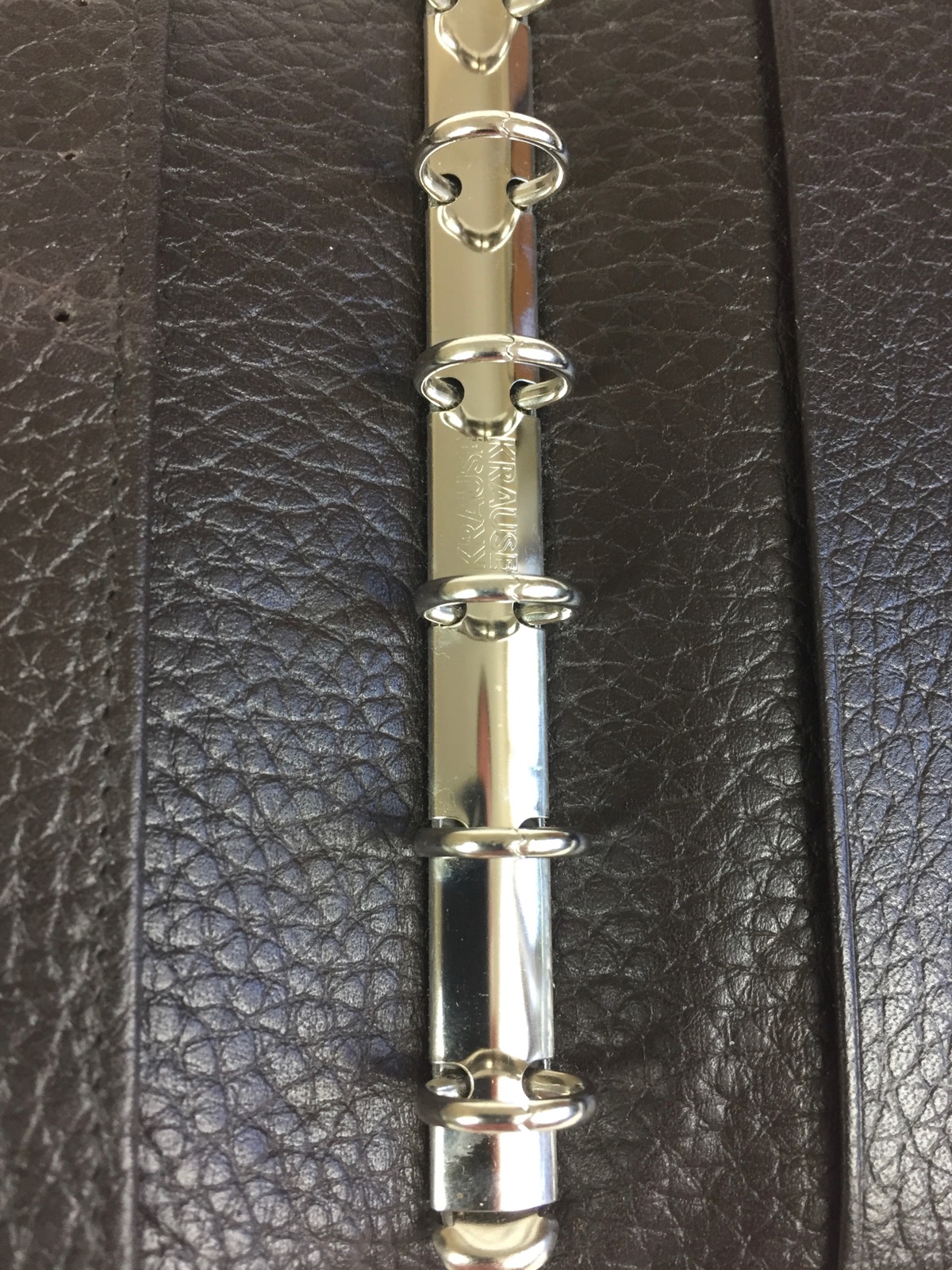
The rings in an organiser vary in quality from cheap non-branded ones that are riveted in to removable/replaceable Krause rings at the other end of the scale.

In cheaper organisers from companies such as Filofax, Paperchase etc the rings tend to be riveted in to the organiser. In some cases these might be replaceable where the rivets go through the spine of the organiser, but on other models they aren't so easy to change.

In the majority of cases you shouldn't have any issues with these rings in normal everyday use. Occasionally you might get some small gaps develop or it might even arrive with gaps in the rings.

Having seen a good number of people with ring gaps on this type of ring mechanism I devised my own method for 'curing' this issue, which you see described here.

However, if you take care in opening and closing the rings this type of mechanism shouldn't suffer any issues. I have many organisers in my collection with these type of rings and I've not had any issues over the years.

Any mechanism can suffer if the organiser is dropped off say a desktop on to a hard floor with a full set of inserts on the rings. So just be careful and you should be ok.

If you are buying an organiser in person be sure to inspect the rings and run the tips of your fingers over the join to check for any misalignment. Your fingers will feel the step much better than your eyes will.

Let's have a look at some different ring mechanisms (Dull Men should look away now!)

Riveted rings in a Filofax Malden
An older Filofax Sandhurst, branded Filofax rings which are removable
Unbranded removable rings in a Gillio organiser
Some tiny Krause rings 11mm fitted in a Pocket organiser
35mm Krause rings in my A5 Van der Spek
If your organiser has the removable type of ring mechanism you can of course upgrade them and fit Krause rings available from Van der Spek. However shipping can be expensive if you only want one set. It is best to get a small group order together to share the cost of shipping.

I've upgraded nearly all of my Gillio organisers with Krause rings, they seem to be better made than the ones supplied with their organisers.

Naturally if you have any questions about rings. Leave a comment below.