The Filofax was certainly an aspirational “must-have” in the mid-1980’s, leading to it becoming (usually in jest) one of the status symbols of the “yuppie” (“Young UPpwardly mobile Professional” or, in America, the “Young Urban Professional”).
However, time management systems and training quickly became a serious competitor to the Filofax (and other brands) in business circles around the world.
The typical Filofax was used as a standalone binder of punched inserts. Although there were many serious users, its contents were often little more than a weekly diary, address and phone/fax/telex numbers, expenses pages and assorted pre-printed (and rarely referred to) reference sheets such as a Chambers spell-checker, post-war wine vintages and international radio station frequencies!
A time management system was perceived by many as a better option. It was still based on a ring binder but promised to be your “results tool”; helping you use your valuable time effectively, plan your schedule and encouraging you to concentrate on your goals and projects. This would free-up more time for leisure activities and a balanced lifestyle. (Like we all have today, right?)
There were (and still are) several different systems produced around the world. I haven’t space to cover the American-based systems here but names such as Franklin, DayRunner and Pro-Planner by Day-Timer are well known. In Europe (but sold around the world), two Danish systems were the leaders.
Time Manager (TMI) was created in 1975 by Claus Møller as “the world’s first results tool”. It still claims more than 400,000 people world-wide use Time Manager as their daily planner.
Time/System with the slogan “Right things in the right time” came along in 1981. It claims to be the market leader in Europe and that more than a million people have used the system as their planning tool. It is still printed in 10 different languages.
Me? I was a Time Manager devotee from 1987. I never attended the two-day TMI course (my company was too frugal) but I devoured the contents of the three booklets that came with my vinyl binder, colourful dividers and assorted punched pages.
Each of the different systems really deserves a post of its own. For now, let’s just ask, what makes a time management set-up different to a standard Filofax?
Taking Time Manager as an example, central to its system is splitting every aspect of life into “key areas” and setting goals for each. With Time Manager, you have nine key areas – typically six for business and three for your personal life. A tenth tab is reserved for “bright ideas” that might come along at any time of the day or night!
Even today, nearly thirty years on, every aspect of my life, business and personal filing systems and entries into apps like Evernote and Informant are still indexed and tagged according to my key areas! These have changed over the years as my life has change. Running a small business, my current key areas are: -
 |
| Still using up 30 year old leaves! |
“The Christmas Tree Principle” is an important way that you’re encouraged to look at your life with Time Manager. The tree trunk is you and the overall goals you’ve set yourself for your private and business life. The branches are your key areas on which to concentrate your efforts to reach your goals. The twigs are the major groups of tasks or projects and the pine needles are all your individual activities.
The idea is to avoid what Time Manager calls “flapsi hapsi” where you’re just surrounded by hundreds of to-dos (the needles) with no overview or clear priorities!
The other big attraction for me has always been the emphasis on long (annual and monthly), medium (weekly) and short-term (daily) planning and the relationship between each. In all systems, you are encouraged to look ahead, get fixed dates such as birthdays, tax returns and summer holidays written down first.
You must plan monthly and particularly the week ahead before the end of the previous week (typically Friday afternoon), setting tasks and deadlines and allocating time to achieve them. Time management binders typically open out so that monthly, weekly and daily pages can all be viewed simultaneously. Try doing that with a modern app!
A third player came along in the UK from 1984. James Noon was a member of the directing staff at Henley Management College and wrote a book called ‘Time for Success’. James ran a number of workshops on time management at the college and these became very popular.
He formed a joint venture company, called Business Time Systems in the UK with International Thomson Publishing. He bought this venture out in 1986 and at the same time he took a distribution license for the Danish Time/System product in the UK, which he combined with his ‘A’ Time ideas and training.
In 1992 he launched his own planning system designing specifically for his book 'A' Time- The busy Manager's Action Plan for Effective Self Management.
Like Time Manager and Time/System, ‘A’ Time became very popular around the world (Europe, USA, Japan, Africa and South Korea). James states that he sold 750,000 books and that (literally) thousands of managers were trained in his system.
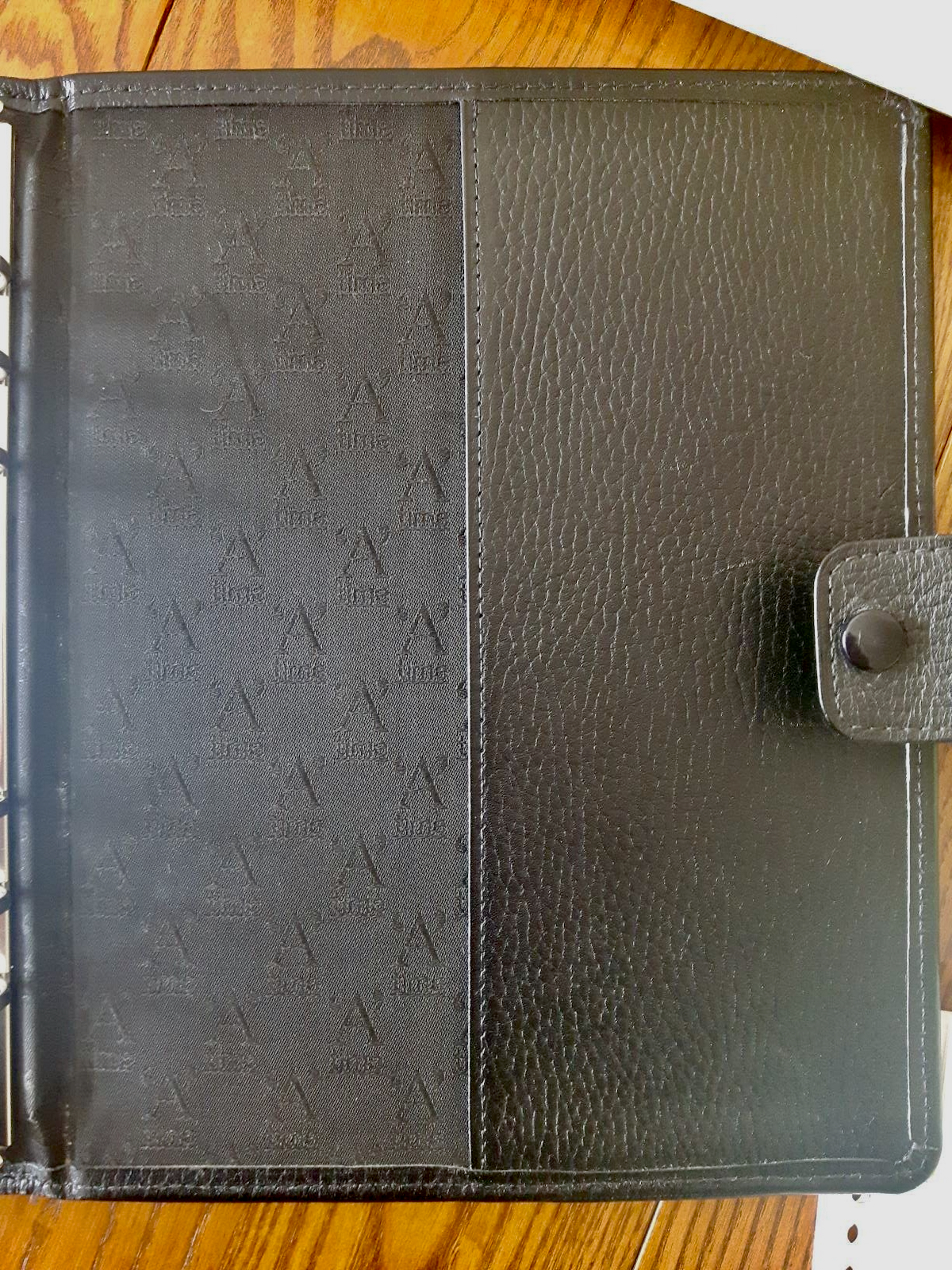
Again, this system deserves a post of its own! Has anyone pictures of an original ‘A’ Time system or pages?
Where did Filofax feature in all this? In a nutshell - it didn’t! With massive sales in the mid-1980’s, it was already a hugely successful company. Profits in 1986, for example, were £1.4 million on sales of £6.7 million. It was only when the company turned heavily loss-making following a collapse in demand in 1989 that the new owners (Transwood Earl) started looking into other products – such as different sized organisers (A5, M2, Deskfax etc) and different markets.
Entering the time management sector didn’t come until the late 1990’s, by which time Filofax was owned by USA’s Day Runner and when paper based time management systems had been largely superseded by electronic PDAs such as the Psion organiser and desktop/ laptop packages. I used the “Time Manager for Windows” programme from about 1993 and packages such as Microsoft Outlook for Windows were well established by 1997.
Tomorrow, I’ll delve a bit into the origins of Filofax Time Management, its’ products and short-lived existence together with a look at the final catalogue from 2006.
Copyrights to all material acknowledged - Tim Edwards, Ilkley Moor, Yorkshire UK