Showing posts with label planning. Show all posts

14 August 2026

Free For All Friday No. 927 by Eve


Why Empty Pages Can Feel So Intimidating

Let's talk more planner theory. Does anyone else get weirdly intimidated by a brand new, freshly opened planner? 

At first it feels exciting, right? Fresh pages, clean layouts, untouched tabs, all that possibility laid out in front of you. Your handwriting is suddenly neater. Your life feels about 12% more under control just by opening the thing!

And then somewhere in the back of your mind, this little voice starts whispering, “But what if I mess it up?”

One crossed-out task, dab of white out or mis-spelled word and suddenly the illusion is broken.

I think a lot of us do this, especially with expensive planners or particularly beautiful ones. We hesitate to write in them because we want them to stay neat, consistent and aestheticly pleasing. Thanks to social media, this has slowly become the definition of a planner “done properly.”

Which is funny when you think about it, because planners are literally designed to contain our messy human lives.

I don't know about you, but my life has scribbles, rescheduled appointments (oh so many rescheduled appointments....), half-finished lists, bad handwriting days, random notes jammed into margins, days or even weeks where everything falls apart a bit.

But somehow cracking open a new planner full of empty pages makes us feel like we’re supposed to become our ideal selves overnight. You know, that other you: the person who meal plans every Sunday, tracks 14 habits, journals daily, never misses a workout, and somehow has perfectly spaced handwriting at all times.

Meanwhile, most of us are just trying to remember whether we already bought toothpaste.

I also think there’s something about a blank planner that feels emotionally loaded. It’s a fresh start. A reset. Proof that maybe this time we’ll finally become the organized/creative/luxury lifestlye/whimsical (insert whatever adjective works for you here) person we imagine ourselves being.

But then life happens, and the planner starts looking… lived in. As I work to let go of my own perfectionism, I’m more comfortable saying out loud that that’s the whole point. 

Some of my favorite planners I’ve used over the years have looked terrible by December 31st. Bent pages, crossed-out tasks, tea stains, sticky notes hanging out everywhere, notes I can't read anymore but knew exactly what they meant when I wrote them. Those planners carried my real life. Frankly I wish more of those types of planners were shown on social media!

What about you, do you hesitate to “mess up” a new planner? Do empty pages motivate you or stress you out a little? 

When you look back at old planners, do you prefer the neat ones… or the ones that clearly got very well used every single day?

As always on Fridays, feel free to discuss anything ring planner related, and have a fantastic weekend!

10 July 2026

Free For All Friday No. 922 by Eve


The Hidden Cognitive Cost of Dual or Multiple Systems

Continuing with my theme of exploring planner theory, and since it is July (of "One Book July" for some of us) I got to thinking about planner systems using more than one book. And I'm talking about for planning here, not having separate books for journaling or art or whatever.

I wonder whether some folks are drawn to dual or even multi planner systems not because they are truly needed, but because they give us a perfectly reasonable excuse to use more than one planner.

And honestly, it's me. I am some folks. I completely understand the appeal! 

One planner can be the polished desk planner. Another can be the portable everyday carry. One can hold the big picture, while the other handles the daily details. On paper, it sounds incredibly sophisticated and intentional and sometimes it genuinely is helpful for those who have found a dual or multi planner system that legit works for their lives. 

On the other hand, in some cases I also think dual or multi planner systems can create a surprising amount of mental overhead behind the scenes. Not necessarily because the system itself is bad, but because your brain now has to constantly keep track of where things live.

Did I write that down in the daily planner or the weekly one? Which planner has the shopping list? Did I already transfer that task over? Do I need to carry both today?

Individually, these are tiny things. But over time they can add up and add stress.

I confess there have been times when I convinced myself I “needed” multiple planners, when really I just wanted the enjoyment of using multiple planners, or the excuse to buy more (I am a fool for a good dopamine hit after all!).

I tell myself that this is a perfectly valid hobby impulse. The trouble starts when the hobby side begins to complicate the functional side. Because the best planning system is not necessarily the most elaborate one. Sometimes it’s simply the one that lets your brain relax because everything lives in one trusted place.

Do you function better with one planner or multiple planners? If the answer is multiple, have you ever given any thought to whether or not you really need them all, or mostly just wanted an excuse to use them all?

As always on a Friday, feel free to discuss anything ring planner related, and have a great weekend everyone!

05 June 2026

Free For All Friday No. 917 by Eve

 The Dopamine Cycle of Setup Culture

One unexpected side effect of finally finding a planner system that genuinely works is that… there suddenly isn’t much left to say about it.

My current setup is stable, functional, and quietly doing its job in the background of my daily life. Which is exactly what I wanted. But I’ve realized that once a system reaches that point, there’s no longer much to do except....use it.

Interestingly enough, that can feel surprisingly uncomfortable for someone (like me) for whom planners are not only a productivity tool but also a hobby of sorts.

So rather than either changing systems just to keep things interesting, or talking about the same old system, I think I’m going to start exploring what I’ll call “planner theory” instead. The psychology and habits behind how we use planners in real life.  

Disclaimer: I'm not a doctor but I play one on Philofaxy (wink)

Have you ever noticed that setting up a planner is sometimes more exciting than actually using it?

Researching inserts, picking a new binder color or model, watching setup videos, reorganizing sections, testing layouts;  it all feels so....productive doesn't it? And honestly, part of the fun of this hobby is the experimentation.

But I think sometimes we confuse novelty with improvement. I know I do.

A planner that truly fits your life eventually becomes a little boring. Not because it’s failing, but because it’s no longer demanding your attention. You simply use it and move on with your day. Ironically, that’s the sign of a good system.

Then there is the FOMO. Part of my entertainment is watching planner content and it is sooooo easy to see something new and different and decide how much better than your current system that new shiny would be!

I, and I suspect many of you, know this cycle well:

new planner → setup excitement → tweaking → "planner peace" → boredom/FOMO → new planner search.

The dangerous part is when you start thinking, “Maybe this system isn’t working after all.” When it may in fact be working perfectly.

I’m curious:  Have you ever mistaken planner boredom for a planner problem? Or abandoned a system right when it was actually working best just for the dopamine hit of setting up something new?

As always on Fridays, feel free to discuss anything ring planner related and have a great weekend!!

01 May 2026

Free For All Friday No. 912 by Eve


Weekly or Daily? Choosing the Right Planning View

The weekly versus daily debate never really goes away; it simply waits until your current inserts start irritating you. Or is that just a me thing?

One of my favorite things about using a ring planner is that if  when your planning style changes, you do not have to stage a dramatic farewell to all of your inserts. You simply pop open the rings (correctly...using the tabs!) and try something else.

The weekly versus daily question comes up regularly for me, and the answer is usually: both work well until they don’t.

A weekly layout is excellent if you like seeing an overview of the whole week at once. Appointments, deadlines, and commitments sit together in one place, which makes it easier to judge whether a given day is already too ambitious before adding three more things to it. 

A weekly spread can also encourage restraint; when space is limited, you tend to write down what matters the most, rather than brain dumping everything in your head.

The difficulty comes when real life refuses to stay neatly inside a small box. A week that looked perfectly manageable on Monday morning can become crowded by lunchtime on Wednesday, leaving arrows, squeezed notes, and increasingly creative handwriting in the margins.

A daily layout solves that problem by offering more space; sometimes glorious amounts of it depending on what size you are in. There is room for tasks, notes, phone calls, reminders, and whatever else appears halfway through the day demanding attention. 

For busy or unpredictable schedules, daily pages often feel more forgiving because they accept that some days simply need more room than others.  Of course, daily pages have their own weakness. It is possible to become so focused on today that the end of the week is suddenly in your face without warning.

That is why many people eventually find themselves using both types of layouts in some form...a weekly view for perspective, and a daily page for drilling down into the details. One tells you where the week is heading; the other helps you survive the day.

In the end, the best format is the one that helps you keep track of real life with the least amount of friction. A planner does not earn extra credit for looking beautifully structured if by Thursday you are writing reminders on scraps of paper because your layout has stopped cooperating. 

So, are you naturally a weekly planner, a daily planner, a "little bit of both" planner, or someone who keeps changing depending on what life currently looks like?

As usual on Fridays, feel free to discuss anything ring planner related.

27 March 2026

Free For All Friday No. 907 by Eve

Planning as a Tool vs. Planning as a Hobby

Now that I’m three months into my “One Year, One Planner” challenge, I’m beginning to see a clearer distinction between planning as a tool and planning as a hobby. It turns out that understanding this difference has been one of the most important parts of sticking with one system up until now.

For years, the two were so intertwined in my head that I didn’t really see them as separate. My planner was both the way I organized my life and the way I engaged with a hobby I enjoyed. This year however, I’m noticing how different these two planner identities actually are, and how mixing them together has kept me in some unhelpful (and expensive!) patterns.

Here’s what I’m learning:

1. Planning as a tool feels steady, while planning as a hobby has lead me to restlessness

A planning tool is predictable; it thrives on repetition, routine, and consistency. But a planning hobby likes novelty, change, exploration, and experimentation.

When those two collide, it’s easy to think, “I need a new planner because something feels off.”

But now that switching is off the table for me, I can tell that the “off” feeling is usually the hobby side causing me FOMO, rather than a flaw in the actual tool itself. 

2. The tool supports my life while the hobby became more about dopamine hits

My planner has been essential for running my day for literally decades. Those pages are where I can find my tasks, priorities, reminders, deadlines, decisions and be reminded of my mission and goals. But the hobby piece was about something completely different - testing different sizes, comparing layouts, reviewing inserts, fiddling with structure, making content for social media, etc.

Both served a purpose but only one is required for me to actually function.

3. The hobby demands change! Whereas the tool thrives on consistency

It’s almost funny how opposite they are. The hobby says, “Let’s try something new! The tool says, “Just shut up and use me every day already.”

The more I stick with the same planner, the more I realize how much smoother my days run when I’m not tearing down my system and rebuilding it constantly for the sake of novelty.

4. Separating the tool from the hobby has made me a better planner

I’m no longer letting hobby-impulses dictate my planning decisions. If something feels off, I don’t automatically assume the planner needs to change. Instead, I ask myself better questions like, "Am I craving change for the sake of change?", "Am I bored in some other area of my life?", "Is it really my panner that feels off, or is it ME?"

5. My planner works better now that I’m not constantly “auditioning” alternatives.

There is something almost magical about committing to one system and just...letting go. A planner really does become more powerful the longer you use it. For me, it has. helped me to stop fighting the format and use it more fluidly.

Three months into this challenge, I’m discovering that planning as a tool is more peaceful and grounding than I ever expected, and planning as a hobby can still exist, just in a healthier, more sustainable way

The year is still young!! Are you still in the planner you started the year with?

As always on Friday, feel free to discuss anything ring planner related.

22 December 2025

The Transformative Power of a Planning System

I discovered Filofax, and planners in general, such a long time ago I forget what a transformative effect they can have on people's lives. Over the years whenever I encounter someone who doesn't use a planning system at all, or maybe just puts appointments into their phone (when they remember), I'm always surprised. I cannot function without my planner. 

Many people seem to think they should be able to hold everything in their mind, and then get frustrated when they forget or double book appointments, fail to plan ahead and prepare for mealtimes, events, maintenance, or simple day to day things. I think a lot of frustrations could be avoided with some simple planning.

For decades I've tried to optimise my planning system. Recently I had an epiphany: most planning systems are designed for people who have never used one. In this case, even a simple planning framework can make a massive difference. Something as basic as writing a prioritised to-do list can bring a big shift in organisation.

I know that a Filofax or any planner isn't a magic wand; no matter what system you use, you have to continuously update it with new information, look at it, and take action. No planner is going to do your actions for you. But even a little planning is better than none. 

I've seen so many people try to go all-in with a new planning system, only to get bogged down and quit because it feels like too much work. 

Some advice for anyone trying a new planner system: start with the simplest, easiest thing first. Add to your system as you discover new needs.

A Filofax is easy to adapt as you need it, with the flexibility to change pages at any moment. For example when you discover you could use a place to write notes about a particular topic, or want some trackers, or cleaning schedules, or monthly reminders for bills, or whatever, your Filofax is there for you. You can try something for awhile to see how it works, and change it as needed.

How did you discover Filofax? What need were you trying to fulfill that brought you to ring organisers, or planning in general?

12 December 2025

Free for All Friday No. 892


Avoiding Planner Overwhelm During the Holidays by Eve

Here we are smack dab in the middle of Holiday Season!! This time of year has a way of turning even the most carefully organized planner into a jumble of lists, events, and last-minute tasks. 

When life starts to feel too busy, I’ve learned that the best approach is to simplify rather than try to fit more in. Instead of stuffing my planner with extra inserts or overly detailing my plans, I scale things back and focus on clarity. I even moved into this lovely Franklin Covey Compact binder with 20mm rings to force myself to stay focused.

Here are a few small tweaks that I make during December:

1.     Prioritize just three tasks a day – This time of year my days are unpredictable, so choosing a “Top 3” keeps things manageable while still moving the important things forward.

2.     Use a master list for holiday-specific tasks - Rather than scattering gift ideas, shopping lists, menus, and event reminders across multiple lists on various days, I dedicate one simple master list for all things holiday. It keeps the chaos in one place. I use a Franklin Covey Progressive Task List for this because it’s sturdy card stock and I can move it easily around in my binder.

3.     Keep your weekly view light - Instead of planning out every hour, I note down only important appointments, key errands, and family commitments. This white space gives me room to breathe and avoid feeling overwhelmed.

4.     Do a 5-minute nightly tidy - A quick flip through each night before bed to check tomorrow’s schedule, migrate unfinished items, and clear out sticky notes keeps everything feeling under control and I find that clearing my head like this even helps me to sleep better.

5.     Give yourself permission to let your planner be “good enough” – This one is tough for me and my Type A personality, but December is not the month for perfection! I simply don’t worry if I forget to pick up my planner for a day or two amongst the chaos, nor do I bother trying to make everything look neat and/or pretty

My goal for 2026 (and the rest of this year) is to allow my planner to support me rather than pressure me. This holiday season is proving to be great practice!

As always on Fridays, feel free to discuss anything ring planner related.

26 October 2023

Passionate About Planning

We are all passionate about planning to some degree. You wouldn't be reading this if you weren't!!

I know some people are more passionate than others, may be. We see various levels of 'planner passion' in our community. 

'The sharers' the people that share their planning moments on various social media platforms, there are some that seem to be putting out videos every day/week. You might wonder how they find the time to do anything on their many lists even. 

I particularly love the people that share their thoughts on different set ups/sizes how they are using their planners and organisers to keep their heads above water in their mega-busy lives, juggling jobs and families and their own lives. 

We all come in to the planner world not quite sure about what will work for us. I've said it before, one size/type does not fit everyones needs, but there is a solution out there for most peoples needs. 

When I first started using a Filofax in 1986/87 there was no magic guide on how to use it. When I look back at my inserts from 1987 I was using it more as a journal than as a planner, my year planner from back then looks more like a planner for future events/meetings. 

There are a lot of us that don't share our set ups/page spreads/flip throughs etc we just use our organisers. They also might answer questions on Philofaxy or on Social Media, giving back their experience and knowledge built up over the years. They are as appreciated as everyone else. 

I occasionally come across people that are Filofax users, have been for many years, but they wouldn't think to look at Philofaxy, or to join a Facebook Group or similar. To them it's just a planning tool, one that they have been using in their own way for years, sometimes decades. It is interesting to talk to these people because they often come up with bits of information about their system or their organiser you might not have realised before or known about. They are in a way a closed book of information that is wanting to be explored. 

There are of course businesses, naturally planners is their source of income, so they are naturally going to be passionate about their products. Mixing these people in with the community of planner users leads to some very interesting conversations and discoveries. They discover how people are using their products and how small changes could improve the products. 

Over time I've spread myself over most of these examples to one extent or another, but I've never stopped enjoying mixing with all people in the planner/Filofax community.

19 October 2023

Planning Ahead

If I have an event or a trip coming up in a few months time, I love the planning phase, almost as much as the event it self! 

Yes I will put my hand up if anyone accuses me of 'over-planning' !!

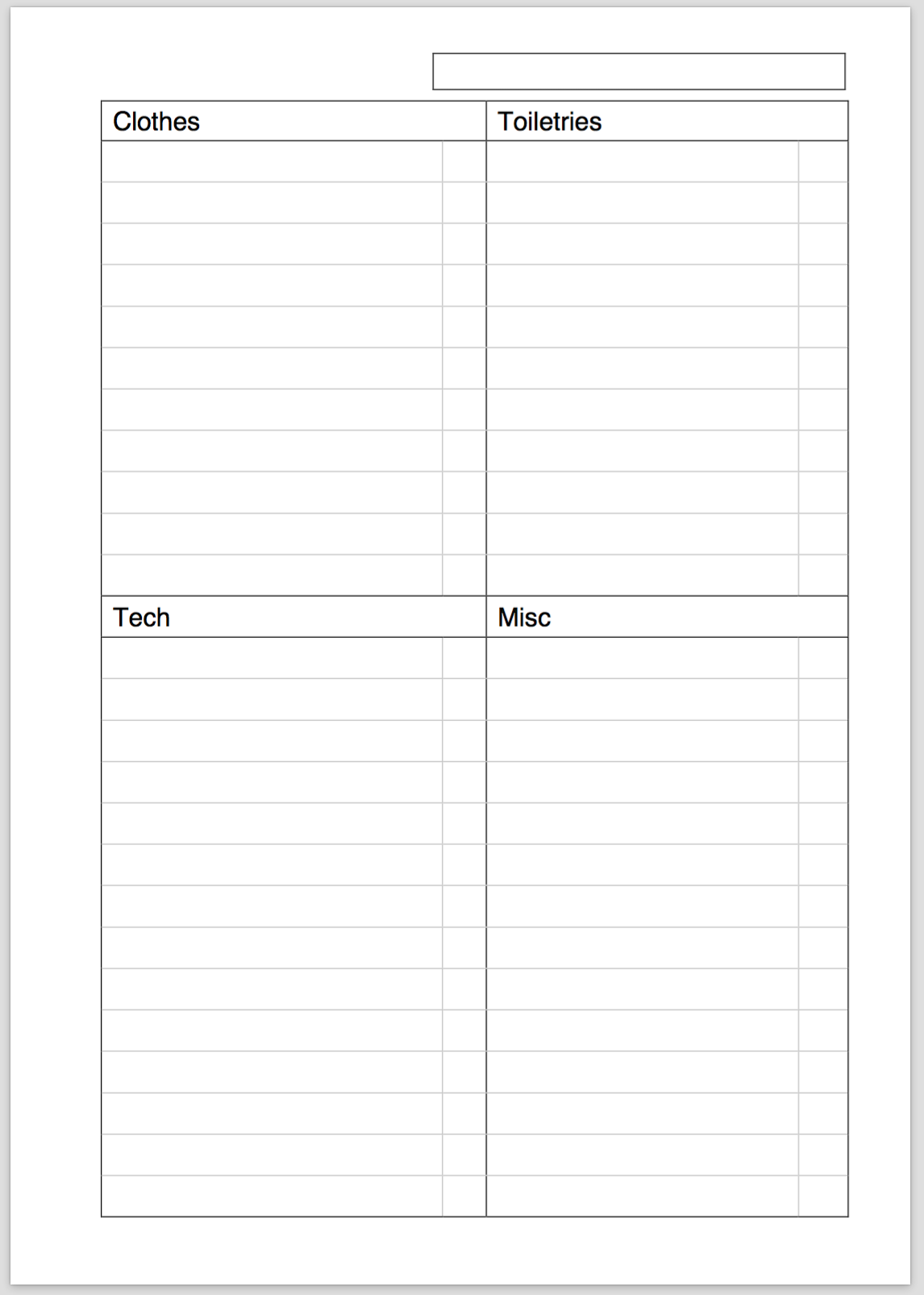
I like to think well ahead of the trip, what I will need to take using my travel packing list, looking at maps, if it's somewhere I've not been to before. 

If I'm driving there I look at the EV charging points en route or near to the destination and alternatives and make a note of those in my organiser. 

I end up with a few pages of information, some on pre-printed inserts that I've created/used for several years, but also using simple lined coloured paper, these pages are inserted close to the date of the event and they 'stand-out' in the stack of pages. I will also insert a 'Today' marker at that week as well so I can quickly turn to that week. 

On my computer I will create a list of sites that I bookmark within Protopage, so they are easy to find again. These might be links to the hotel, shops nearby, transport sites etc. 

If I'm going by train or by air, I print off my tickets and my hotel reservation details. Yes, I know there are e-tickets, but I still like to have a paper copy, even if I don't use them on the journey! They are there 'just in case' 

When it comes to packing... and what luggage I will use, that is when we are getting close to the departure day. I'm ticking off things on my packing list to make sure I've not forgotten anything. I have some favourite bags that I use for short weekend trips for carrying the variety of items needed these days! That's a whole topic in itself! 

You would be correct in thinking that I don't like 'last minute' or 'being rushed' 

I use my Filofax Travel Wallet to carry tickets and documents etc.

I've started to use a 'On return' list, so nothing gets forgotten when I get back home to France. 

Do you enjoy planning for events? With Christmas approaching, there is no harm in getting ahead of the last minute rush, use a dedicated section of your organiser or a separate organiser, a slimline or compact may be. 

25 October 2018

Forward Planning?

How far in to the future do you plan things in your organiser?

A week? A month? Up to a Year? Two or three years ?

However far in to the future you plan, there are solutions for you on Philofaxy.
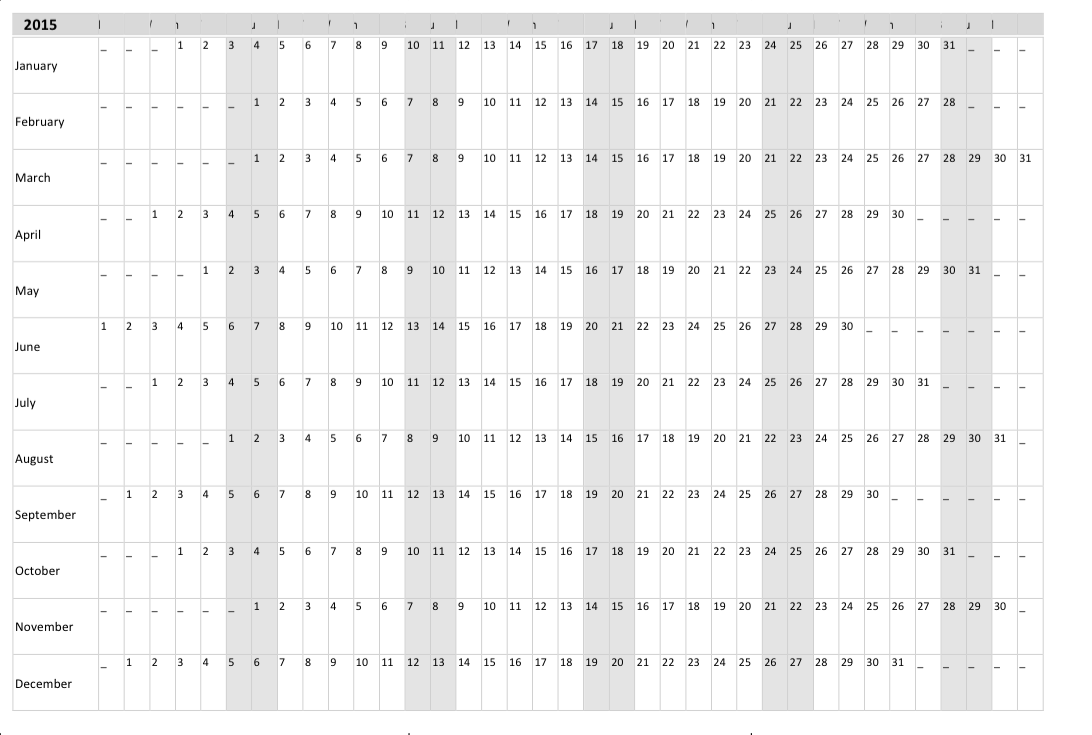
Beyond 2021 you can of course create your own inserts using the source files of our inserts listed above. Or alternatively used some of the 'Undated' inserts which you will find on this page

07 February 2018

Your Organiser and Your Profession? - Reader Question

This topic was suggested by Gaynor during the Philofaxy Round Table Skype chat last weekend. I thought it was a great discussion topic and wrote it down quickly!

The question she posed was 'Does your job/profession influence how you plan in your organiser?'

I thought about it for a moment and of course in some jobs I'm sure there will be an influence.

Teachers I would think would be more at home with diary inserts that mirror their academic year. I wonder if accountants would prefer ones that started and finished with the start and finish of the tax year?

Then there is the type of layouts people prefer, does a vertical layout work better for some jobs compared to a horizontal layout?

Let us have your thoughts in the comments below. But I would also be very pleased if any of you would like to submit a short guest post on how your profession influences how you use your organiser.

18 April 2016

Long term planning

As part of our discussion on the next podcast we discussed planning in to the future.

How far ahead do you plan in your organiser? And what do you use?

Let us know in the comments.

17 March 2016

Renaissance of Paper Planning?

After talking with people at the meet up last weekend and listening to their comments, a radical thought slipped in to my mind on the journey home.

Did we start a renaissance in paper planning?

Think back about 5 or even 10 years and there wasn't the same level of social media usage, the same amount of activity on blogs or You Tube.

In the last 5 years I think you will agree that we have certainly seen a massive interest in paper planning, or an increased awareness of it. Not just in ring bound organisers but in paper planners in general terms.

Now if you look at how the commercial companies have reacted to this increase in levels of activity.

Filofax have just about managed to keep things ticking over they are still seen as the big seller in the organiser market. Their market share though has reduced in the last couple of years.

However, their dominance is being attacked at all price levels with companies coming in to the market such as Kikki K, Websters, Paperchase  all producing colourful organisers at the lower price range.

The discovery of Gillio and Van der Spek at the luxury end of the market has also made people think about spending money with Filofax in the hundreds of Dollars, Pounds, Euros price brackets.

Did we start a revolution? Have we saved a few companies from going out of business, or at least saved them from stopping organiser production/sales. And with the increased activity in the world of social media have we encouraged new companies to come in to the market?

I wouldn't claim to have done this singled handed... no it has come out of a lot of mutual co-operation and a lot of networking and bringing people together to share their love and passion for paper planning.

I looked around the restaurant on Saturday evening and thought. Who would have thought that all these people would have come together to share so much laughter and so much shared values more than 5 years ago?

More than 5 years ago you would never have thought that your organiser was the key to the growth of  your circle of friends! It just makes me smile and happy to think what a wonderful community we have created.

03 December 2015

Daily or Weekly?

If you attend a meet up don't be surprised when people not only show each other the organisers they have brought along with them, but also the fine details of how they use them.

Now to me this is the interesting bit. It is that one chance you will get to see the detail and the workings of someone else's organiser. I'm not talking about the personal details the such and such appointment on a particular day, more about the level of detail people are writing down each day or each week. The sort of information people record on a daily or weekly basis.

A lot of people use their planners and organisers to record health information, helping them track their weight or symptoms.

It is interesting to see how people mix the use of ring bound organisers with bound notebooks, traveller’s notebooks for planning and journaling.

I know in my own case the notes I make in my organiser might not make much sense to someone else. I don't write in code, more a short hand I suppose! As example a task that just says 'Flip 14th 17th' might not make any sense to you, but it is my prompt to 'Flip articles to Flipboard from web finds on the 14th and 17th of that month'

Generally there tends to be a lot of 'white space' on a typical week view of my organiser, it is only rarely do I fill up a particular section of the week layout that I use, so I guess I've got the size/layout about right. There are some peoples organisers I have seen that are crammed full, every page is full. I admire these people in a way for having such busy lives and being able to cope with so many things happening.

I knew I wanted to slow down when I 'retired' five years ago... may be I've taken it too far... answers not required ;)

So the question which triggered my thinking this morning. Do you plan on a daily basis or a weekly basis? I know if you do plan on a daily basis then you have to also have a long-term sight on the week ahead or the month ahead (likewise if you plan by the week), but what is your main focus when looking at your planner.


21 August 2015

Free for All Friday No. 353

Do you plan for procrastination? I don't mean planning procrastination into your life; I mean procrastinating instead of doing. I'm guilty as charged. Today I spent an hour planning my upcoming month when I had important work to do right at hand. The very work I had planned to spend the morning doing.

I did the planning because I had a lot of odds and ends in my head, and I needed to get them into my planner so I could focus on my work. At least, that's what I told myself. And now I've run out of excuses.

21 August 2014

APATT* Nan's Goals and Projects Book

*All Personal All the Time

In addition to the Filofax I carry every day, which for 2014 is a Personal size with 2DPP diary and Slimline A-Z tabs, I need a separate book for projects, ideas, lists, and budget tracking.

As mentioned in my earlier post about the Filofax I use for work, I've been using solely Personal size so for this year, just to see whether I can do it. Here are the six Personal Filofaxes currently in my life:


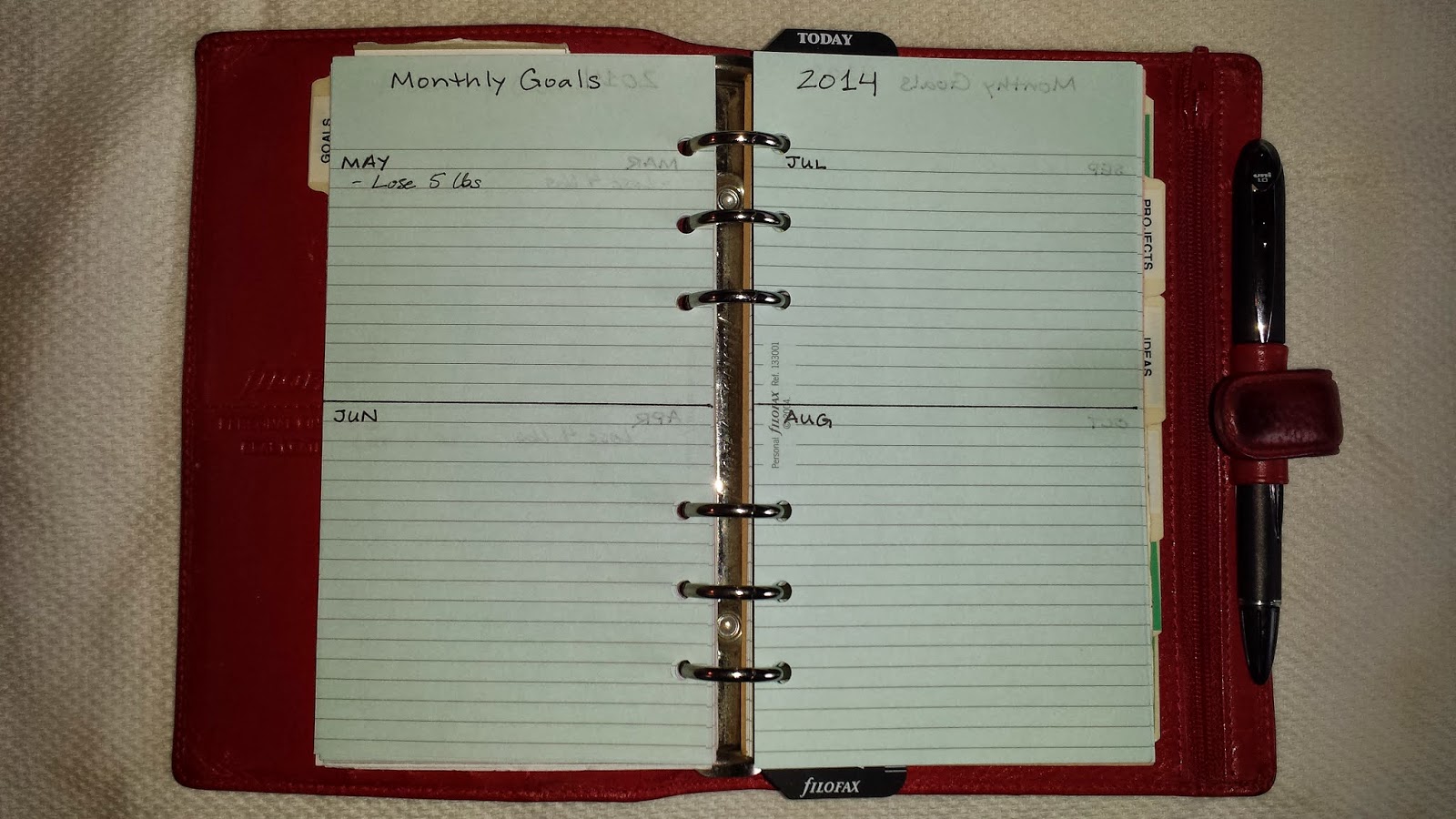
The Goals and Projects book is a red Finsbury that I bought in 2006. It was my everyday calendar Filo before an ink-blue Cuban took over that role, and I love red, so it holds a warm place in my heart. It has seven tabs: Goals, Projects, Ideas, Budget, and tabs for three local organizations I'm involved with. These activities started out as projects, but expanded enough to require their own notes section. 


My goals setup is inspired by the goals pages in Laurie's Plannerisms planner. In keeping with APATT, I just used some blue Personal paper and a pen to create pages for yearly goals, quarterly goals, monthly goals, and weekly goals. 


The weekly pages have checkboxes for each day of the week. 
In the Projects section, each project starts on a yellow page. Filofax used to make Project pages, but they're hard to come by. Besides, by using a ruled page, I'm not limited by the structure of a project form. On subsequent pages, I take notes on white ruled paper. 


The Ideas section mostly contains lists of books I want to read, stores and websites I want to visit, places I want to go, and so on. 


In the Budget section, I use Filofax's forms to track personal spending—I allow myself a certain amount each month for haircuts, makeup, meals out, and other fun—and tax-deductible donations as I make them. 

The last three sections hold my meeting and work notes for each organization. As you can see, I don't have trouble writing on Personal size paper. In fact, I think it helps me take better notes because I have to be economical with words. 


05 June 2014

Guest Post: Graphical daily planning - Graham

Thank you to Graham for this guest post on graphical daily planning. 

Our lives all look pretty different, and we all have different ways of organising them.  This is reflected in the myriad of systems and layouts we each have to organise our Filofaxes.  Some people don’t feel comfortable with the list and block layout that most diary inserts take, and there’s been quite a lot of interest in systems which provide a more graphical representation of our days.

These systems make use of our familiarity with analogue clock faces and develop from there. There’s a basic problem with a clock to show our days because one round of the clock only covers half the hours of the day, so many of these graphical systems have had to evolve away from the clock face and use colour coding to increase the visual usefulness and impact of the graphic.  There are also the inevitable clashes between systems using a 12-hour clock system (most of them), and those using a 24-hour system (my own preference).

I have seen inserts with two empty clock faces on each day’s page, one for the morning and the other for the afternoon and evening, but I find these confusing. I automatically continue planning after midday on the morning clock face, forgetting to move across to the other. This isn’t a system commonly used and a more refined system is called for.


Patrick Ng’s Chronodex system (see his blog at http://scription.typepad.com/blog/2011/11/scription-chronodex-weekly-planner-2012-free-download-with-the-cost-of-a-prayer.html#.U4XWNzjBZaQ ) might have been the one that gave this move towards graphical daily planning wings. It pulls the two clock faces into one, being based on a typical 9 to 5 working day with space for a few hours before and after to plan events outside those times. The single graphic covers 18 hours, and when it’s filled in it gives the most pleasing representation of time of the systems I’ve tried.

However, planning anything in the hours outside 09:00 to 21:00 is ineffective, and its spiky layout and initially unintuitive nature has put people off and set them looking for alternatives. 


The Chronodex


Kent from Oz created the popular Spiraldex (See his video and blog post), which is visually more pleasing to many than the Chronodex system and, by moving a step away from the clock face paradigm by using a spiral, it allows more hours to be planned. Several people have made their own versions of this to suit their own lives, for example the Pingadex (blog, and video) .

There are aspects of this device that I find problematic, though. Each hour’s segment doesn’t get the same amount of space, and whilst there is space to write notes outside the segments between 12:00 and 21:00, this isn’t the case for the hours between 6:00 and 12:00, so notations are often written with lines or arrows crossing the other segments. My sense of balance and symmetry is easily offended, and this doesn’t really help me to visualise my day.


The Spiraldex


Naturally, after fiddling with some other offerings, I put my hand to designing my own layout! I wanted to make a step back towards the clock face paradigm and make a system more suited to the way I work.

My own thoughts and preferences, like everybody else’s, is relevant to my own situation. I don’t have a 24-hour lifestyle and don’t generally need to refer to what happens before 8:00 or after 21:00 (though if I am doing something during those times I would need to be able to add it or draw it in somewhere). My life also isn’t event orientated and most of what I do is recurring, so I manage tasks on a computer, not in my Filofax. I really want to be able to see at a glance not only what I have to do, but how much time it will take and therefore how much time I have left over. I wanted equal spacing for each time period, I wanted something that distinguished mornings from afternoons, and I wanted spacing around all sections for any relevant notations.

This is my initial attempt.


When filling it in, I draw a line to show a time period where something is happening or may happen, but which won’t occupy time completely, such as a delivery window, and fill the segment with a block of colour when there is a fixed appointment where nothing else can be planned. As the segments are the same size and all have a space around them for notes, this allows me to easily review how much time is assigned and how much is spare.


This is clearly just a prototype. The graphics need sprucing up and the 21:00 and 15:00 aligning, etc.  It might be improved by thickening the bands, only starting at 8:00 in the morning, adding more concentric rings to help with colouring in, drawing lines to delimit the hourly segments, adding 15 minute dashes and adding more hour numbers. I’m very open to hearing what people think of this system and how it could be tweaked to make it more useful to more people with different ways of working.

Feedback?  Let me know!

Graham Rhind http://www.grcdi.nl/author.htm

17 April 2014

Should weeks start on a Sunday or a Monday?

For various reasons I didn't have a very good week last week. So this week I was determined to put last week behind me and start this week with a clean sheet... or in my case a new week per view set of pages in my A5 Filofax organiser.

So in the right frame of mind I sat down this morning to plan what I needed to do and on which particular days they needed to be done one etc.

It got me thinking... always a worrying sign... Why do some people prefer diary inserts or calendars that start on Monday and other people prefer ones that start on Sunday?

What is your preference and why....

06 September 2013

Filofax Meal Plans?

Just a curiosity type question from me really... Have you ever thought of creating a 'Meal Plan Filofax'?

The sort of thing I was thinking of would be say Personal or Pocket size, may be something that is wipe cleanable (if that is a real word!) so not leather.

In the organiser you would have meal ideas in a sort of index card system. On each card or page would be the details of the meal, information on ingredients, cooking method, time to prepare or time to cook, location in your local store of all of the ingredients (aisle numbers may be)  Other notes etc.

Then as you use each one, it gets moved to the back of the system so you have a fairly varied diet. Or you could sort them in to categories, may be on preparation time, or in to say meat dishes, cold dishes, hot dishes. So you can match your time constraints or to match the outside temperature.

Do we have an idea here for some specialist inserts I wonder? Let know your thoughts in the comments below.

02 January 2013

Guest Post - In Praise of Planning - David Popely

Thank you to David for sending in this Guest Post to share with you his thoughts on the start to the New Year.

So, Christmas is over, and Santa has brought you all, or most, of the things that you asked him for. And among them for many of you, if my Twitter feed is anything to go by, was a shiny brand new Filofax. OK, for some of you, I know this will not be the first time Santa has done this (or that you’ve done it yourself), but again, if my Twitter feed is anything to go by, there are a lot of people out there holding their first ever Filofax in their hands right now.

So if this is your first Filofax, maybe you have found your way to this excellent site via Google, word of mouth, or some other means, and if you have it may just be because you wonder……what do I do now?

I hope regular readers of this blog will forgive a slightly more ‘entry level’ piece, but the fact is that if you’re new to Filofax, and even if you’re not, the tidy piece of leather/plastic/whatever, and paper, which  you now hold in your hands can be the means to fulfilling all your goals, the things you’ve been ‘meaning to get around to’ but never have - yet.

However, there’s a catch. Unfortunately, like iCal or Google Calendar/Tasks, your shiny new toy, massively useful as it is, will not do this great task of helping you to reach your goals and ambitions on its own.

In short, you’re going to have to do two things. You’re going to have to plan, and you’re going to have to execute.

Back in the 1980s when planning and time management were actually popular (at least in the junior management ranks I used to inhabit back then), these skills were taught and were expected to be learned and mastered, but things have changed since then. Somewhere along the way we became convinced that modern technology had solved the problem, which we no longer needed to plan anything at all, because Outlook would magically make everything better.

To expect Outlook, Google Calendar or iCal, or any other technological panacea, to make everything work together properly is about as sensible as expecting your tools to get out of the toolbox on their own and build you a wardrobe.

Here’s one of the models which was popular back in the 1980s for demonstrating the benefits of a ‘planning phase’ before an ‘ execution phase’:


Notice how the longer planning phase on the second line leads to a much shorter, more ‘tidy’ execution phase, meaning that the total time for planning and execution is shorter than the upper line, where planning is compromised for the sake of making a start.

I’ve been looking at my Twitter feed for #filofax quite closely, and the impression I get is that the majority of people posting are now busy ‘filling in their diaries’ for 2013. I’ve got news for you. If all you’re doing is ‘filling in your diary’, then you won’t reach your goals in 2013. If you were given a Filofax with the standard 5-part index dividers, take a look at the other tabs and you’ll see one further down the set called Projects.

That’s where you need to start. Make your plans, set your goals, and then, and only then, put the things you need to do to achieve those goals into your diary. I’m not going to tell you today how to do this in detail – hang around this site for a while and you’ll discover that for every person contributing there’s a method of planning which is different, particular and customised for that person’s needs.

And we all love to share. No really – we LOVE to share, at length. Great length. So I’m not going to tell you what is the right way to do this because you’ll have to find out what’s right for you. But what you need to know is that you must plan, or you won’t achieve anything you intend to. And its New Year Resolution (aka goals) time, isn’t it?

So please, from one Filofax enthusiast to another, use this wonderful, marvellous tool you now have in your hands, to let your New Year be  really new year for you, the year in which you don’t just accept the agendas of others as your own, because if you just ‘fill in your diary’ with the commitments you’ve already made, that’s exactly what you’ll be doing.

I hope you understand that I mean this in a kindly way. I know most of them are your friends, but their agendas are not your agendas, and if you don’t follow your own agenda, your unplanned time will flow in the twin directions of others’ agendas and your own weaknesses. Take a minute to think about whether that’s *really* what you want for 2013. In short:-

Whose life is it, anyway?

A Wise Man of Industry in the UK once said,

“Show me your diary and your bank statement, and I will show you your priorities”

I think he was right. How about you?