Showing posts with label personal. Show all posts

16 April 2026

Guest post series - 'Filohax' No. 28 - Paul

Thanks very much again to Paul for this next instalment of his wonderful guest post series. 
You can find all of the 'Filohax' posts here.   
There is an index of all the previous Filohax posts here

Just enough space

I've been using Filofax personal format inserts off and on for nearly 40 years and it's only just occurred to me why this format has proliferated for over a century... 'There's just enough space. '

The 6 ringed binder that has gone on to be called 'Personal' or 'Bible' size was always intended to be a portable housing for technical information sheets - for taking 'off site', so portability was essential (the original ring size may have been a slim 1/4 inch, only big enough for slipping into an overall pocket). 

(Here a couple of posts by Steve about personal size, in case you'd like more details - https://philofaxy.blogspot.com/2022/06/personal-size.html and https://philofaxy.blogspot.com/2018/01/why-is-personal-size-still-most-popular.html)

The depth 
But why the portable size that it is? I think this was dictated by an average handwriting size writing a list that covered 31 days, a day per line. I don't think it's a coincidence that after a space for heading information there are 31 lines...so that covers the depth of the page.


The width
Again, an average hand will be able to write 7 or 8 words on a personal insert line - just enough for a to-do item.

Disadvantages versus advantages 
There is a downside to this 'just enough' format - it's not really large enough to write, for instance, a daily journal on one side. However for me, it's a trade off - in the past whenever I've tried journalling in larger format bound journals I've given up before too long as I mainly journal 'on the go' while out and about and these weren't portable enough for me.

However since I started journalling in personal format I've been doing it daily for 3 years - a compromise that works for me, how about you?

27 November 2025

My Transition to Personal Size - Choice of Organiser

As I previously posted, I will be using Personal Size next year for the first time in quite a few years. I've been using A5 size organisers since about 2006, so it is time to have a change.

One thing that has changed since I last used Personal Size (full-time) is that my collection of different organisers in that size has grown, different models, brands and ring sizes.

Personal size I think has the largest range of ring sizes available. They go from 11-13mm in slimline size. Through 15-16mm in compact. 23-26mm in regular size rings, and the biggest are 30mm in internal diameter.

Most if not all Slimline organisers don't have a clasp, some don't even have a pen loop, so they will slip into a jacket pocket easily. I do have a DeVille organiser that is like a Slimline in design, no clasp or pen loop, but it comes with 15mm rings which is unusual but a useful addition in my collection.

As the ring size increases the overall size of the organiser increases along with the weight. This especially applies to the two-part organisers such as my Gillio Mia Cara and Moterm Versa, both Personal Size, but quite a size compared to say a regular Malden.

Detailed research on ring capacity.

Doing some research, I found this table in one of the Filofax catalogues.
 Ring Size  
 Organiser SizeCapacity (Sheets)
30 mm
A5, Personal Zip  
330
25 mm
A5 Clasp270
23 mm
Personal Clasp250
19 mm
Pocket200
15 mm
Compact150
13 mm
Slimline, Mini120
11 mm
Slimline, Mini105

It does list the capacity in terms of the number of sheets of paper, but I assume that is 70gsm sheets of paper. My own inserts are printed on 80gsm paper so the capacity will obviously be less. 

A slightly more accurate method is to measure the thickness of your stack of pages. Krause give paper capacities for their different ring sizes:

The ring capacity is given in the specification sheet as a thickness of paper on the rings. Krause quote their rings by the external diameter, were as we normally quote the internal diameter. The letters and numbers in () are the Kruse model numbers which you will find on page 21 of the catalogue in the link above.
  • Pocket (PER152/06/20) - 20 mm internal diameter - Paper capacity 14mm
  • Personal (PER171/06/25) - 25mm internal diameter - Paper capacity 19mm
  • Personal (PER171/06/30) - 30mm internal diameter - Paper capacity 24mm
  • A5 (PER216/06/25) - 25mm internal diameter - Paper capacity 19mm 
  • A5 (PER216/06/30) - 30mm internal diameter - Paper capacity 24mm

So as a rule-of-thumb, take the ring internal diameter in milli-meters and subtract 6 mm and you have the paper capacity in milli-meters.  You should be able to apply this rule-of-thumb to any brand of organiser with similar size rings. 

Putting this information to use

I've measured the total thickness of my diary inserts plus other pages that I intend to carry. I've also tried them in various organisers in my collection. 12 months of the diary inserts on their own will just about fit in a 15mm organiser such as the De Villiers or Holborn Compact the later having a pen loop and clasp 

Larger ring Filofax organisers with 23mm rings can take all of my diary inserts and a parred down selection of additional pages. 26 and 30 mm ring organisers can take the full set of pages. 

If I cut down how many months of diary pages I carry and may be use a year planner for the rest of the year then 13 or even 11mm Slimline organisers can be utilised. 

Therefore I have plenty of scope to try out most of the organisers I have in my cupboard!  

As you might be able to tell, I'm quite looking forward to trying out Personal Size again. 

16 October 2025

DiY Personal Size Storage Folder

Thank you for all your suggestions on ways of storing Personal Size inserts. 

I came up with this cheap and simple solution for storing past years of my Personal size diary inserts. The earliest being 1987. 

I've used some card stock which is about 160 gsm. But you can use what ever you can find. Mine came in A4 size. 

Using a trimmer I cut it down to 245mm x 190mm, I folded it so that the 'covers' both front and back were 110mm in width. This gives enough clearance if you have any tabs in your stack of inserts. 

The problem then was how to punch the holes. I did it in two goes. Fold the front right over and punch, then do the same on the back. 

As you will see you do end up with holes in the spine but that shouldn't be an issue with card stock for the folder. 

I then passed the treasury tags through the holes in the front and back cover. 

You can make the spine thinner if you wish. Mine is about 25mm, but it will depend on how many inserts you want to store in each folder and the length of your treasury tags, they do come in a variety of lengths and colours. I found 4 tags was enough to hold my inserts securely. 


Folded over for punching. Do the same on the other fold.


Having made about 4 of these (they don't take much time to make) I then received a hint on my previous post that Kraft binders do exist for Personal size but they are labelled as A6 on Amazon! Typical!! 

I ordered a pack of two. Like the A5 ones, they have 20mm rings and seem to be good value for money and they aren't made of plastic. 


You can find them on Amazon UK and Amazon USA You will find the A5 binders on the same links too. 

Now to just sort through my past inserts and decide which ones to keep and store them in a more organised way. 

06 October 2025

ISO: Personal Inserts Storage?

You might recall I found a simple and neat solution for storing A5 insert/diary pages etc. You can read about that here


I've been looking for a similar kraft board equivalent in Personal size. But I've not found them yet, unless you know of some? 

Filofax make some that are a couple of posts in a plastic cover, not so easy to look through without removing the pages, but fairly compact. 


The other option I'm investigating at the moment is to use 'Treasury Tags' and a simple folded card cover. This is a work in progress to get the dimensions correct. My first prototype didn't quite work! Back to the drawing board. I will share the sizes once I've mastered it. 

These will be simple, cheap but functional. 


How do you store Personal size inserts? 

17 July 2025

Guest Post - Going to Personal from A5 - Zsu - Part 2

Continuing this excellent by Zsu, you can catch up with part 1 here

Back to Personal

It was not an easy decision, but a decision had to be made: I could no longer carry my planner, no matter how much I loved it. I had doubts about the smaller size, and I wasn’t sure I could do it again. And so I went back to my old Personal Size inserts, to remember from my own handwriting, how I could fit my days in that size. I leafed through the old pages and old notes to gather courage. Thankfully, I also had the help and guidance of my friends at the Philofaxy group, who helped me decide on the best planner. I wanted something in leather so it would last and grow old gracefully, and something zipped, so I could make sure I would not chunk it up beyond reason. (Hey, you can dream, right?)


The size shock this time wasn’t so bad, because I did had all those old inserts to remind me what was it like then. I did a lot of the moving of data through resizing and printing inserts and information on smaller formats, and then gave myself the chance to work with the known inserts, the ones that came in the planner, to reacquaint myself with the size. The old inserts gave me a guide to find my footing, and I enjoyed being able to use smaller bags as well. And my old crone back was really happy with the new size!

It helped that I went back to erasable pens, but also that I went with thinner-line pens, (from 0.7 mm to 0.5 mm and 0.38 mm), but also switched from M nib fountainpens to F and EF nib ones. This simple change helped me shrink my handwriting and still write “readably” – for my standard.

Once I was set, I noted some of the “problem areas” I was finding in the new size, like the lack of space for notes in my weeklies. I went to social media to investigate possible inserts and printed out several mockups to try out, tweaking them each time until I found the one that suited me better. And I must admit, it wasn’t the one I was expecting. It was by trying out and experimenting on printed out test inserts that I found the one that worked for me in Personal size: the Plotter weekly.

This is my third year back in Personal size, and it feels like I have been in it forever. Admittedly, I’m not one to change planners constantly, and once I’m in a size, I want to stay in it forever. It gives me a sense of certainly to know where to find things in a page, how to fit the planner in a bag and what I have where. Life has many surprises and uncertain things, and I don’t need my planner to be also a source of unexpected.

Closing Thoughts

Changing sizes, or even picking a size, is a personal decision. Maybe some of us are more flexible to move from one size to another, and can fit our plans in different types of inserts and sections. Some of us find it more difficult. The way to find out, however, is to try it out. But you don’t need to spend upwards of $100 or 100 € or £100 to see if a smaller size would work for you. Instead, look for old inserts, or a sample pack or just print out a couple of pages in the size you want to try out, punch them for the rings and give it a couple of weeks. Copy in them your busiest weeks, look at them, see how you feel with the size, try different pens and writing tools, and if it feels like something you can do, that it can work for you, splurge on the planner, and give it a try for real.

And if it doesn’t work for you, well, you gave it a try.


My eldest nephew is already at the university, and he loves pizza. One day I went to pick him up, and on the way home we stopped by a pizza place. He can eat a huge pizza all by himself but not me. And usually the pizzas I like, he doesn’t like. So we were at this pizza place and I wasn’t too hungry, so I asked if they had personal size pizzas. They had not, only one size (big). And then, the boy at the counter said something funny:

“Any pizza is a personal pizza, if you believe enough in yourself.”

Well, the same goes for the planners: “Any planner can be the right size of planner for you, if you believe enough in yourself”.

I did not get that pizza, not because I don’t believe enough in myself, but because I know myself. With the planners, yes, there may be a bad back, or weaker eyesight that might condition the planner size you can get, but maybe, really, you can find your way and be happy in any size you feel like trying out. 


Again thank you to Zsu for her detailed description of her move to personal, it gives me confidence that my similar move next year will not fail in week 1 of 2026!

14 July 2025

Guest Post - Going to Personal from A5 - Zsu Part 1

Thank you to Zsu for this excellent two part post about her transition from A5 to Personal size. 

If you have stopped to read this, you probably have been there. Planner already in hand, and pondering about moving to a different size. A smaller size. Can it be done? (Sure, it can, you most likely have seen people do it all the time online, but the question is, can you make it work?) It can be tempting to try out a different size, because one size may have more options than others, or because it’s easier to find inserts or make them for some sizes than others, or even because a particular size fits easier in your life, whether you want it open on your desk, ready to catch copious amounts of notes, or you want it to easily fit in a bag so you can take it on the go and not break your back while at it. Or you simply want to try something new, challenge yourself, see your life in a different size, make use of those rings you have stashed or you see in the store.

So, can it be done? Or more importantly, what’s the shift like?

The Story

Throughout my life I have had a lot of planners. I am one of those people, who, at a given moment in time, had a Pilot PDA (PDA: Personal Digital Assistant), and always liked to write a lot. And I mean A LOT.

In my childhood, I remember seeing a movie where a man had the most amazing planner, with sections and colored tabs. A Filofax. I didn’t care much about the plot of the movie, but I knew I wanted to have a planner like that one day. For context, I live in Costa Rica, so finding a Filofax or any ring planner in here was harder than finding a magical bottle with a genie in it. I did look, but it seemed that the fabled ring planners didn’t exist in real life. Pilot PDAs did appear eventually in stores, so that tell you about how markets work.

During the pre-Filofax days I planned in different planners, with different sizes, eventually setting with those bound planners that give you a day per page with hours running down the margin, in half Letter size. I became accustomed to that size and the routine of it. Each year I went looking for the perfect planner, with the best font, lines that were not too thick nor contracting too much with the page, and once I’ve got it, I spent a couple of days copying addresses and phone numbers from one planner to the next, as well as birthdays, and yearly due-dates. The PDA was an attempt at skipping this process, but the electronic devise had its own setbacks, and didn’t fit me.

Going Personal the First Time

Eventually, thanks to the Internet, I learned that ring planners and Filofax did exist and I could order a planner online, and so I went to research. I went to research sizes and binders, and even cut out the paper sizes out of scrap paper to decide with would fit me better. This was the first time I went from Half Letter (or almost A5) to Personal size.

Here I debated a lot, but in the end I decided to pick the size that would fit most of my bags. And then I did something that has helped me a lot later on: I grabbed all my previous planners and looked for the smallest I had to see how did I manage in that size. I compared the planner with the cut out page to try to imagine planning in that space. I did had a small planner, and I figured that, if I was able to use that, I would be able to use a Personal size planner, after years of Half Letters.

When my first Filofax arrived, I didn’t know what to think. The binder was bigger than I expected, and the page seemed smaller. (I did not consider the allowance for the rings). Had I made a mistake? I had ordered daily pages, but soon realized that I would not be able to fit a whole year in the rings, so I had to discard that. It was disappointing, but I was not going to give up so easy. After all, I had spent a lot of money, or what was a lot of money for me then. And so, I gave it a try.

If you wonder how do I plan, I usually have day and time specific appointments (meetings, appointments, due dates), and tasks. There are some day specific tasks, but most of my tasks are either weekly or longer projects, where I like to note whether I have finished them or not. Other than that, my planners also tend to be a collection of random notes and ideas, which makes a ring planner ideal, because then my notes are not interspersed through all the days contained in it, but can be relegated to a specific “notes” section.

In the pre-filofax days, a DPP (day per page) type of bound planner gave me plenty of space to scribble on the “free spaces” any note or reminder about a book or a movie I was recommended, or the name and details of a contact for a project I was working on. Clearly, that was no longer possible with the Personal size Wo2P (week on two pages). My notes, thus, went into the note section. But, would my days, my tasks and maybe my eventual quick notes fit into the new, reduced space?


I copied the addresses and phone numbers, and other important data in the index pages, and set up the planner. I was already consuming lots of planner content online, that gave me ideas on how to better use the paper real estate I had. I learned to divide tasks and appointments in columns and make my handwriting smaller, to fit more of it. Color coding and highlighting were my main tools to pack pages chock full of text and yet be able to separate one topic from another. I learned to develop codes, be efficient, and use the best elements of ring planners: you can have sections for anything, so your notes don’t need to go in your calendar pages. And I was even able to fit a random, quick note in the calendar as well. (Spoiler alert: once the shock was over, I continued peppering my calendar with quick notes, even when I had the Notes section. That’s why I keep the whole year in the planner: you never know when will you need that number or that name you scribbled down sometime in February.)

When my first planner met an early demise (the clasp broke), I went for my second planner, also in Personal Size. I remained in that one a couple of years, until the faux leather cover was peeling so badly my bags were dirty all the time.

That was when I moved to A5.


Enter the A5

The third time I bought a Filofax, I knew I needed to get a leather planner that would last. I thought a lot about it, did research, watched loads of videos, and finally a friend suggested a Malden, and also an A5 Malden. They had on, so I could see it “in the flesh”, and I was sold. I never liked the pictures of the Malden, but in person it was a thing of beauty. I debated on the size because I was used to the Personal size by then, but taking notes in a Personal size did feel constricting, and I ran out of paper fast. So I said, “why not?”. And I got one.

I had to give up bags and consider what would I carry in the bags that did fit my new planner, but the experience was amazing. All that space! That planner stayed with me the longest so far. It went with me from the Filofax inserts, to my own inserts, through my years of bullet journaling until I emerged on the other end of it, back into printed inserts. It went with me from the pre-pandemic days into the pandemic, from one university degree to the next, from one project to the next. The leather got scored and aged, like the face of a faithful warrior or a wise old shaman that has seen the world and stands proud on the top of the hill, facing the sun like an equal.

But I grew old(er) as well. And after the pandemic was giving up and we were properly vaccinated, I packed my old bag, and carried it on my shoulder, like I have done for so long, and realized that it had become too heavy. After being used to carry bags weighting around 8 to 12 Kg on daily basis, with my “absolute essentials” before the pandemic (yes, I had weighted it a couple of times), I had lost that strength thanks to the many days of working from home. A bag weighting 7 kg was just too much. Something had to give.

Part two will be coming soon.... Thank you to Zsu for her detailed story on her transition to Personal size from A5. 


12 June 2025

The transition from A5 Filofax to Personal Size Filofax

As a long term user of an A5 Filofax (this is my 20th year in fact) I have contemplated changing back to Personal size several times in the last few years, having started in Personal size back in late 1986 (yes nearly 40 years ago!) 

I've also been using the same Enhanced Time Management A5 insert since late 2011, so why change you might ask. 

As well as a large collection of A5 organisers (about 24) I have a similar number of Personal size organisers, plus a small number of Compact and Slimline size. 

In addition over the years I've collected an abundance of Personal size inserts of one sort or another. (A shoe box full, the universal measurement of spare inserts!) What was stopping me from making the change?

A5 has worked so well for me over the years, but may be the smaller size could be made to work just as well. 

First of all I looked for commercial inserts that might fit the bill, but for one reason or another I didn't find any that would fit my own requirements. 

I set to work on creating an insert of my own, a miniature version of my A5 Enhanced Time Management insert. However, in Personal size when I tried it out for a couple of weeks I don't think it would have worked for me, the restricted space on each day was going to be an issue, unless I could tame my hand writing and that has been a problem for the last 60+ years!!! 

Daily inserts would also be great, but that is a lot of paper to carry around, a compromise would have to be met by restricting to say only having 4 months of inserts in the organiser at any one time and make use of a monthly insert or year planner for more long term planning. 

Seeing your week ahead with dailies results in lots of page turning. Then I hit on the idea of two days per page. Would that work? 

I grabbed our existing files for that format and on screen I could see it certainly had a lot of potential. 

I started with file 2.3.2 on our 'Future Diary Inserts' Page. 

I did a couple of tweaks to the file to include 'Tasks' on each day and printed off a couple of weeks of inserts, cut them to size and populated the days with appointments and tasks I had recently had in my A5 inserts. 


I considered printing on to Personal size paper, this would have saved a lot of cutting and punching, except when I tried it, the printer mangled up each sheet that went through it. Back to the drawing board!

In the end I had to print on to A4 paper (two Personal sheets per A4 sheet) and then cut them out. With 108 sheets to cut to size I got quite good at cutting the pages to size by eye. However, it did take several hours to do. 


If I use Personal size on a long term basis I will certainly consider investing in a heavy duty paper cutter. One that can do 50+ sheets at once and make accurate and square cuts. It would save me a lot of time. 

In addition to the diary inserts I also gathered together all of my Personal size inserts in boxes and in organisers and sorted through them. Reusing some that I already had from a while ago. 

In some cases I had to recreate inserts I've been using in A5, but in Personal size to give me the same flexibility as the A5. 

At the moment with the inserts printed on Clairefontaine 80gsm paper it all fits into a Filofax (or similar) with 30mm rings. But with a little bit of thinning down the extra sheets I think I can get my 'fill' to fit in a standard 23mm Filofax, this will give me more choice from within my 'collection' 

Here is a video I did earlier this week describing the inserts and the change over. 


I'm quite looking forward to using Personal size again. I already have some appointments cropping up in 2026 to write in and no doubt more as we progress through 2025. 

I also like the certainty of having the files to create these files in future years and not have to worry about multiple languages or QR codes or them being discontinued etc.

Have you decided yet what you will be using in 2026?

16 November 2023

Making Filofax Personal Size Your Everyday Organiser

A lot of people use Filofax Personal Size, most probably more than any other size in the range of sizes available. 

If you are not using Personal Size here are some things to consider that might get you to change your mind about using it or changing to it.  

  • It has been available for the longest period of time of all sizes, so there are plenty of organiser designs and styles available. 
  • Ring sizes from as small as 10/11mm to a whopping 30mm. The smaller sizes being slim enough to fit in to a jacket pocket or take up very little space in your handbag/purse
  • A large range of inserts are available including pre-printed ones from a large range of suppliers. 
  • Price range of organisers is vast, from a few £ € $ to hundreds, but you don't have to spend a lot of money to get an organiser that is perfectly functional. 
  • Vintage organisers.... true vintage as well are available.
As with all sizes, you should test out the page size with just some sheets of paper (95x171mm) to see if your typical week in your own hand writing is going to work or not. Also this will help with what sort of diary insert you are going to need. 

The most common size of rings is between 23-26mm, in those sizes you will find a vast range of organisers to choose from both in clasp closure and zip closure. Mostly they will only have one pen loop, some have two pen loops. 

The larger 30mm ring organisers in Personal Size if you fill them up can become quite bulky. With the Gillio Mia Cara with 25mm or in the case of Moterm Versa 30mm rings you can have a two part organiser, with an outer 'jacket' and a separate inner organiser. These can carry a lot of supplementary paper work, but they are much bigger and heavier, but they both still use Personal Size pages. These are not the sort of organiser you can easily put in your pocket!

Gillio Mia Cara (Medium/Personal Size)


If you have been using an A5 or larger organiser, adapting to the smaller page size might take a while, but don't give up, give it some time, a week or two at least. 

One disadvantage for me is that Personal Size pages aren't in the same height/width proportions as the regular ISO sizes (A4, A5, A6 etc) this means that a Personal Size page has to be specifically designed for that size, not just simply scaled down from a larger size. Also printing Personal Size pages on that size paper can be tricky if your printer is a little fussy about the smaller size pages. 

Have you considered changing to or back to Personal Size? 

27 July 2023

Prototype Inserts for Personal and Pocket Size.

Following the release of a new insert recently for A5 organisers. I had a couple of people request something similar for Personal and Pocket Size. 

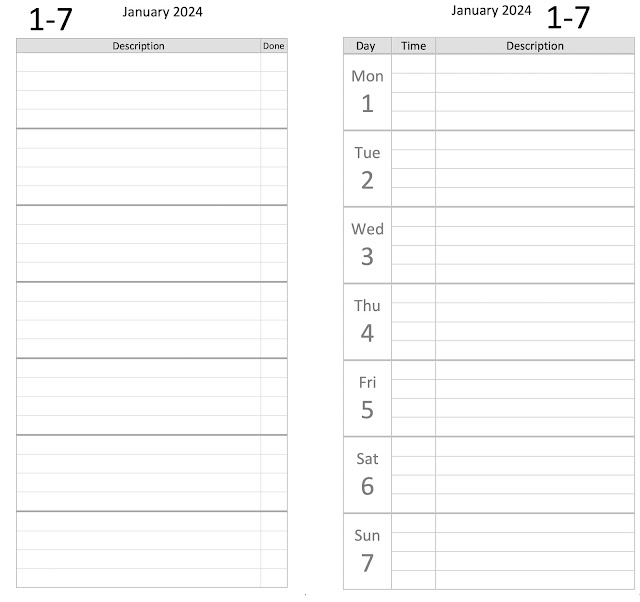
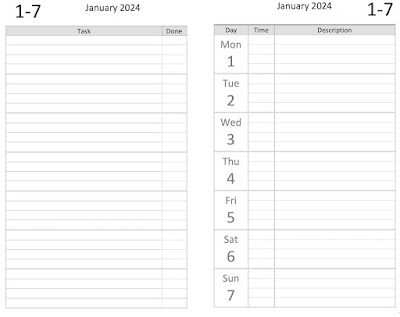
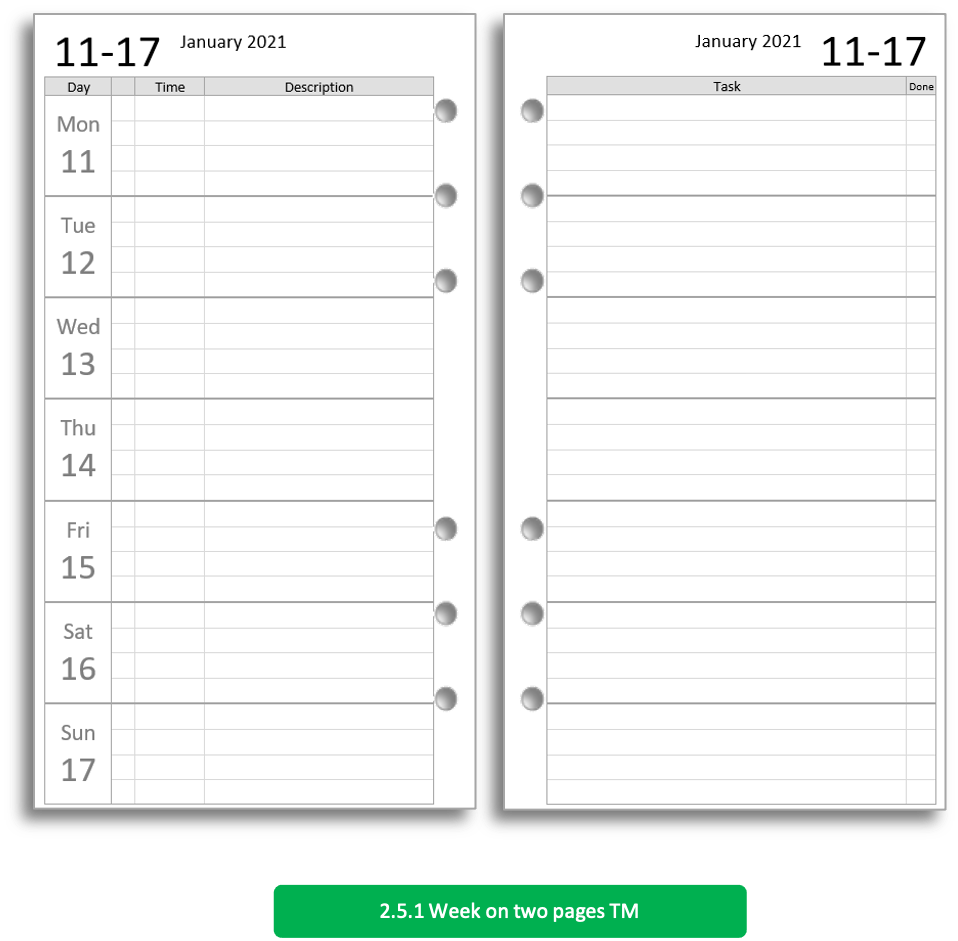
Given that we already have similar inserts in those sizes (2.5.1 and 3.4.1) I realised already that there wasn't a lot we could do in those sizes apart from reverse the pages, so with the tasks on the left and appointments on the right. 

Personal Size

Pocket Size

It would be possible to redesign the tasks page and divide it up differently, but I suspect everyones requirements are going to be different. Therefore as usual we are making the source files available so you can 'have a go' yourself! 

These like the original files are printed on to A4 paper, then you can cut out the pages and punch them accordingly. 

I've also created a set of files for 2024 as well. 

These inserts aren't going to be added to the diaries page just yet because I don't think there will be a huge demand for them? 

The 2024 files ready to print are available here:

The source files are here for both sizes. You will need both the Word and Excel files. 
Creative Commons License

This work is licensed under a Creative Commons Attribution-NonCommercial-ShareAlike 4.0 International License.Please download, adapt, use, share, but do not charge or use commercially.


09 June 2022

Personal Size

A question was during the Skype Round-Table/Meet Up on Sunday. 

Where did Personal Size come from? 

The page size as you will all know is 95mm by 171mm, this translates in inches to. 3.75 by 6.75 

We have to remember that the size originated in the early 1900's in the USA, so it wouldn't have been measured in metric millimetres back then! 

I started to think that may be the original Lefax pages from the 1900's where a slightly different size, but as you will see, this original 1928-1929 calendar page is exactly 95x171 mm in size.


Normally paper sizes tend to be related to each other rather than existing on their own. I have been trying to find what size Personal Size is related too. 

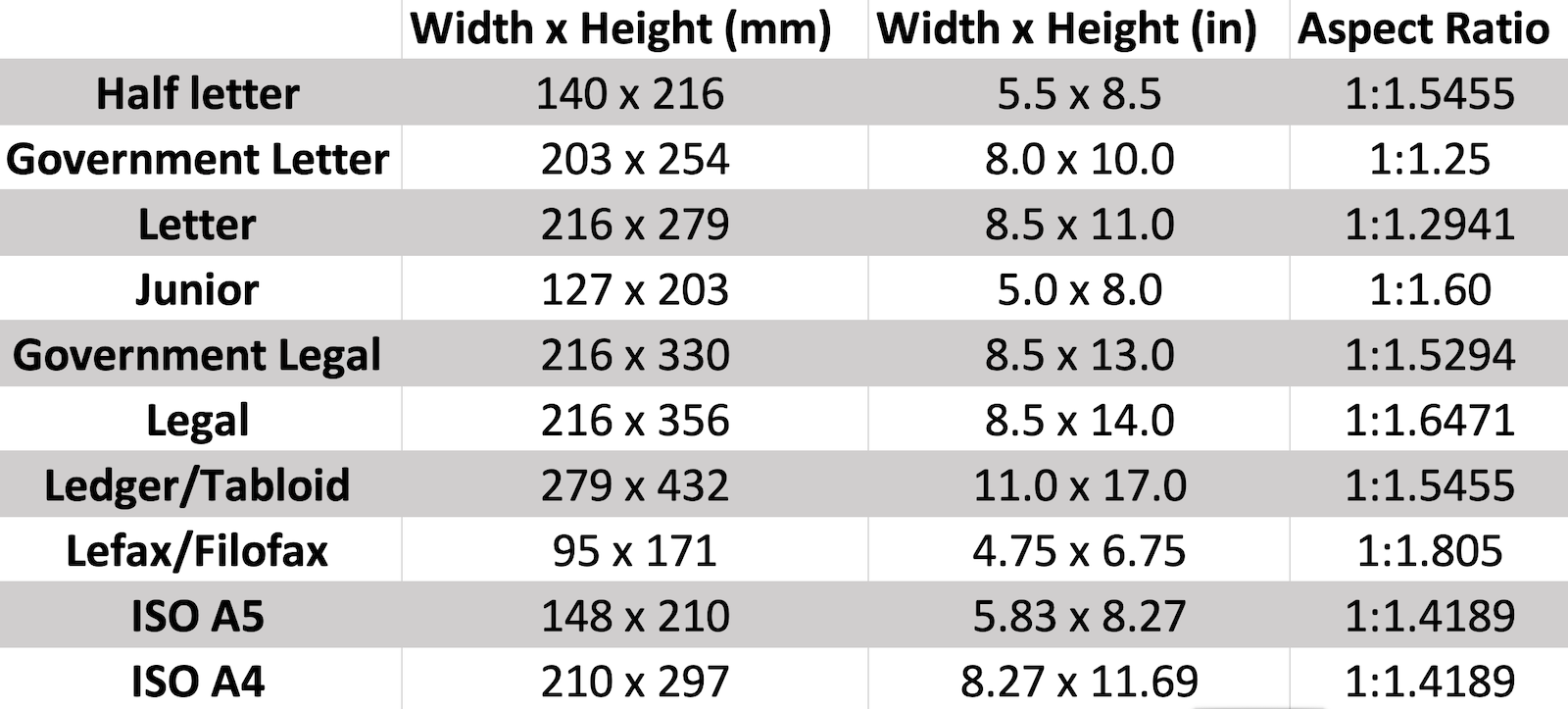
Here is a table of all the common US sizes and I've included the Filofax Personal size and ISO A4 and A5 for comparison. 


I have studied the sizes and not found any obvious relationship between Filofax Personal Size and the common US paper sizes.

Looking at how Personal Size relates to ISO A4 size shown below in blue, you can fit three Personal Size pages on the one sheet (green, orange and red) This as you can see leaves you with two waste areas at the side and the top, but when printing the thin strip on the right is in fact the bottom of the page so that will be ok for the paper feed on most printers. 

I went on a hunt for a related size to Filofax/Lefax Personal Size, but sadly I've failed this challenge. I even looked at old English paper sizes (there are many) but none of them seemed to be related to Personal Size. 

For now this mystery will have to remain as it is, just that a mystery. Unless someone out there knows different? 


17 August 2020

Moterm Versa Personal - Review

The Moterm brand is a relatively new name to us in the planner community, but it is a brand that has an ever growing fan base as they continue to bring out new models at affordable prices and at a rate that seems unbelievable as they react positively to customer suggestions/requests.

Given the amount of interest I've seen on You Tube and Facebook, I decided to take a look for myself. At the end of July they announced another new model, the Moterm Versa in personal size, they had previously brought out the Versa in pocket size and it sold out in days!

I ordered a Moterm Versa personal size in black leather via Ali Express. There was a choice of colours available, but I went with the black rather than a pastel colour. Call me traditional if you like!

My order was confirmed within a few hours of me placing it and they estimated that the delivery date would be 13-16th August, it arrived on the 13th August. I was able to track the progress of the order from start to finish. There was no problems with payment, my account was debited on the day of despatch.

The item was very well packaged for shipping with a stout outer carton, inside was a simple presentation box containing the planner inside a cloth dust bag both showing the Moterm brand name.


The Moterm Versa is a two part organiser. There is an outer 'jacket' and the organiser itself, in addition they also include a leather flyleaf and approximately 100 sheets of undated lined journal type pages.


Together the two parts make up quite a substantial planner/organiser.


There are a lot of pockets in different sections, and card slots in different groupings we well. There are two places for pens/pencils. The inside of all of the pockets are lined with a cloth material that will not stick to plastic cards that you store in them.


The outer jacket, it has a full width back pocket that is 320mm in length and 195mm deep, almost big enough to take a full A4 size sheet of paper, but not quite.


On the inside front cover you will find four card slots visible on the pocket flap. Behind the pocket there is a full height slip pocket.

The pocket is held closed by two poppers top and bottom. Open it up and you then find a full height zipper pocket, five more vertical card slots and another full height slip pocket behind the card slots.


In the spine of the outer jacket there is a slot to hold a pen or pencil.

The rear inside area of the outer jacket you will find five more horizontal card slots with an ID pocket at the foot of that section with the Moterm card and tag next to it. Behind this section are three full height slip pockets. The deepest one is used to hold the back cover of the organiser section in place.


On the outside of the cover there are two places for the clasp popper to be closed in to, this gives you the option of additional capacity should you really need it.


The removable organiser can be used on its own, you don't have to use it with the outer jacket. The outside of it is in leather, likewise the inside is in full leather as well.


The front inside cover has four horizontal card slots as well as a deeper business card pocket at the foot of that section. Behind this there is a full height slip pocket for holding additional papers.


The flyleaf which is held on the rings has a leather and elasticated pen loop as well as three horizontal card slots on the reverse side.


The rear inside cover of the organiser section doesn't have any pockets so it slips in to the outer jacket easily.

The rings are attached with a simple bolt arrangement, which makes them easy to change. They are 25mm internal diameter in a silver finish. Moterm have other rings available on their store site in silver, gold, and rose gold finish in 25mm and 30mm size. I've ordered a set of 30mm rings to assess their suitability for the Moterm Versa for width. I think it might be ok, but I will report back when they arrive, hopefully soon.

[See my review of the 30mm rings in my Moterm Versa]

The organiser also came with 100 sheets of undated lined journal type pages.


The outer cover and the organiser both have some form of stiffener present in the covers between the leather and the inside. This is only there to help the organiser keep its shape and it doesn't impact on the ability of the organiser to lay flat when opened.

The leather it self is pleasant to touch. There was a slight chemical smell to the leather, but this has disappeared by leaving the planner out of the dust bag and box for a day or two. I've also given the leather a wipe over with some leather care solution that too improved the smell of it.

The organiser doesn't seem fragile, the rings snap closed in perfect alignment each time. The stitching is very good and also consistent on all edges at quite a high stitches per inch all around.

The edges of the leather are all neatly finished there are no rough edges or stray threads on the stitching.

Dimensions: The Moterm Versa measures as follows:
  • Organiser section (Open) 290 x 185mm
  • Organiser section (Closed) 138 x 185 x 32mm
  • Outer jacket section (Open) 335 x 208 mm
  • Outer jacket section with organiser section installed (Closed) 170 x 208 x 45 mm
Please note that the thickness of both when closed will also be dependent on the contents of the pockets and rings. 

Weights:
  • Organiser with flyleaf = 240 g
  • Outer jacket = 272 g
  • Both combined 512 g
Please note that the above weights are with the rings and all pockets empty. 

All of the above I have kept to my usual style of being objective as possible, my usual technical type description, but I'm sure you want to know my own opinion and what it is like etc.

They often say 'You get what you pay for' and that is true of most things.

I bought the Moterm Versa out of my own money. I paid €76.54($90, £69) including shipping. I didn't opt for express delivery, I went with the standard shipping to France. It arrived within the time limits and without any issues.

The buying experience was not a rushed one it all went smoothly and there is plenty of feedback about the status of your order and when it is shipped and the tracking details etc. The tracking number worked with LaPoste my local mail service as well.

I would say that it is certainly worth the money I paid for it and the overall quality is comparable to other organisers I own at the same price point and much higher too. How many other organisers have the grand total of 21 card slots!!??

If you want to see how it compares to other brands, I recommend looking on You Tube there are plenty of comparison videos on there, so you will get the opinions of other people as well as just mine.

Further Information:

Moterm planners are available via their AliExpress page or Amazon USA I am told they are still working on their own website.

There are also groups on Facebook the main one is fully supported by the company.

13 August 2020

Changing Size?

Have you ever seriously considered changing the size of organiser you are using on a daily basis? Not just going for a different ring size, but a different page size as well.

This post is for you, to help you through the thought process and it is one I've been going through this last couple of weeks or so.

For more years than I can remember I have been mainly using A5 as my main 'go to' size organiser. However, like most people I did start in personal size, well there wasn't many other options back then! I get these occasional hankerings to return to personal size.

This year being what it has been in terms of you make plans only to have to change them a few days or weeks later. I guess I'm not alone in looking at my organiser and seeing how my requirements this year have changed.

My starting point in this exercise is my A5 Enhanced Time Manager layout, I've been using it since mid 2011!


Obviously I have been using a current year version! I started off by looking through recent weeks to see what parts of the layout I used the most. At the moment it tends to be the right hand page more than the left hand appointments side.

I had bought a personal size insert earlier in the year on the off chance I might migrate in to that size, also to use it in photographs so it looked more up to date, it was in one of the many sales that Filofax France have held this year!


The new paper they are using is an improvement over previous versions. I like this layout because it is just one language, which leaves more space to write in. However, it is mainly focused on appointment type entries although I'm sure I could adapt it with a few extra drawn lines to include tasks and notes.

On a recent shopping trip I spotted the Quo Vadis Timer 17 inserts on sale at our local shops. I bought this insert to try out.


The first problem with this insert is that the size is slightly bigger than Filofax Personal at 100mm x 171mm, I trimmed off 5mm off the outer edge of each sheet. That didn't take too long to do and it solved that problem. The paper is excellent, no bleed through at all with my usual rollerball pen. Whilst the lines for appointments make life easier, the time range tends to suit a working day more than evenings. The space at the foot of the page could be used for tasks. However in recent weeks my task list has been more than would have fitted in that space. I could use a supplementary To Do list page. Like my current A5 insert though I don't have enough appointments to fill in that space.

At this point I realised if I was going to find a suitable replacement I would have to think harder about my actual requirements otherwise I would quickly end up with a stack of unused inserts!

Then I found this one in our Philofaxy personal on personal size paper inserts. It is the 4. Week on One Page Plus Notes/Tasks and you can find versions of it for 2020 and 2021 available on the Diary Inserts pages.


The appointments size gives equal space to each day, a plus point for me, it is unlined, but they could easily be added to the design if required. In my limited tests so far there are enough lines assigned to tasks for most weeks. 

For my initial tests I've only printed about 5 weeks of this design on ordinary Filofax white paper,  not the best quality, it is some I bought a few years ago and it seems to absorb gel ink a little too much for my liking, but it is fine with a ball point pen.

As I'm printing on to personal size paper, there is no cutting or punching required, so whilst it is tricker to print, there is less work involved to finish off the inserts. 

In conclusion, if you are thinking of changing page size of your organiser please consider the following:
  • Do you really need to change sizes? Obvious really, but would a change of insert format in your current organiser size improve the use of your organiser. 
  • Look at how you use your current inserts so you can decide what you require from your new inserts in terms of page space. 
  • Have you used the new size previously? 
  • Do you already own an organiser and accessories in the new size? 
  • Test out potential inserts in the new size for at least a couple of weeks? 
  • What other inserts will you need in the new size? Test those out as well if possible. 
  • If you don't own an organiser in the new size, test just some inserts in the new size for a couple of weeks before you purchase an organiser and accessories. You might save yourself a lot of expense if you find the new size doesn't quite work for you. 

I will let you know if I make the jump back to personal size or not. 

Have you ever seriously considered changing the size of organiser you are using on a daily basis?


05 November 2018

Width Guide

Whilst doing research in to B6 organisers, I was looking through past postings on the Van der Spek Facebook group and came across a variety of posts about Van der Spek Custom organisers that had been widened to take different width pages.

There seemed to be some confusion about the additional width required for different brands/designs of planner pages.

Here is my take on this problem.

Page Size Actual size Additional Width(mm)
Personal/Standard 
171 x 95 mm 
0 mm
Franklin Covey  
 172 x 108 mm 
13 mm
Personal 'Wide' 
 172 x 121 mm 
26 mm
B6
 176 x 125 mm 
30 mm

Remember Personal size is the same as Standard in Van der Spek language. Same page size, same ring spacing etc.

Van der Spek also offer the option to increase the length of the clasp, but please note that the clasp length is independent of the organiser width.

Therefore just because you have increased the width it does not mean you have to also increase the length of the clasp as well.

Increasing the length of the clasp just means you can stuff more paper in to the pockets!

If in doubt ask Petra for advice on the options.
Further Information.

Web Site: http://www.vdsshop.com
Facebook Page: https://www.facebook.com/VDSleathergoods
Facebook Group: https://www.facebook.com/groups/vanderspekorganiserfans/
Instagram: https://www.instagram.com/vdsshop/

04 March 2018

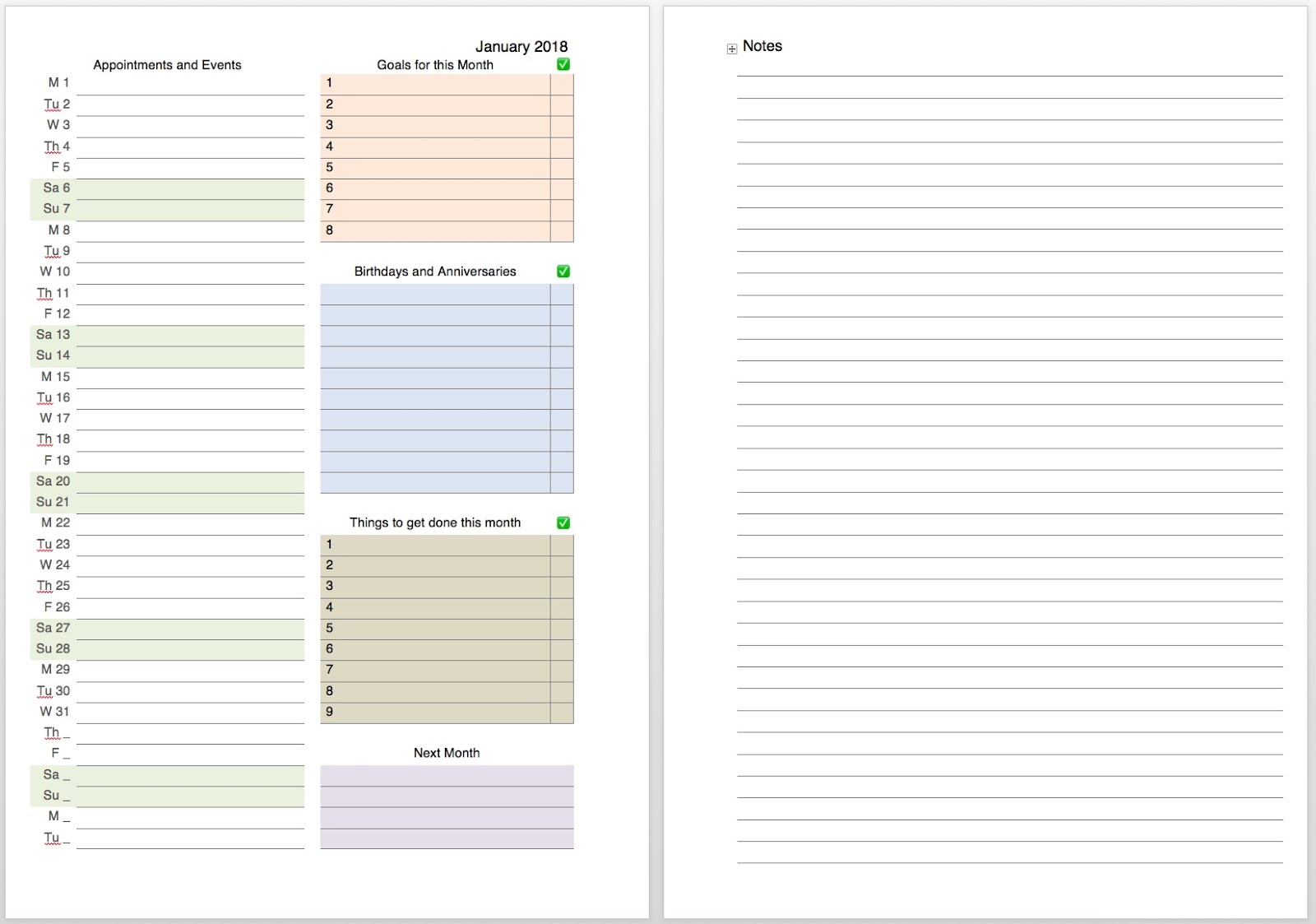
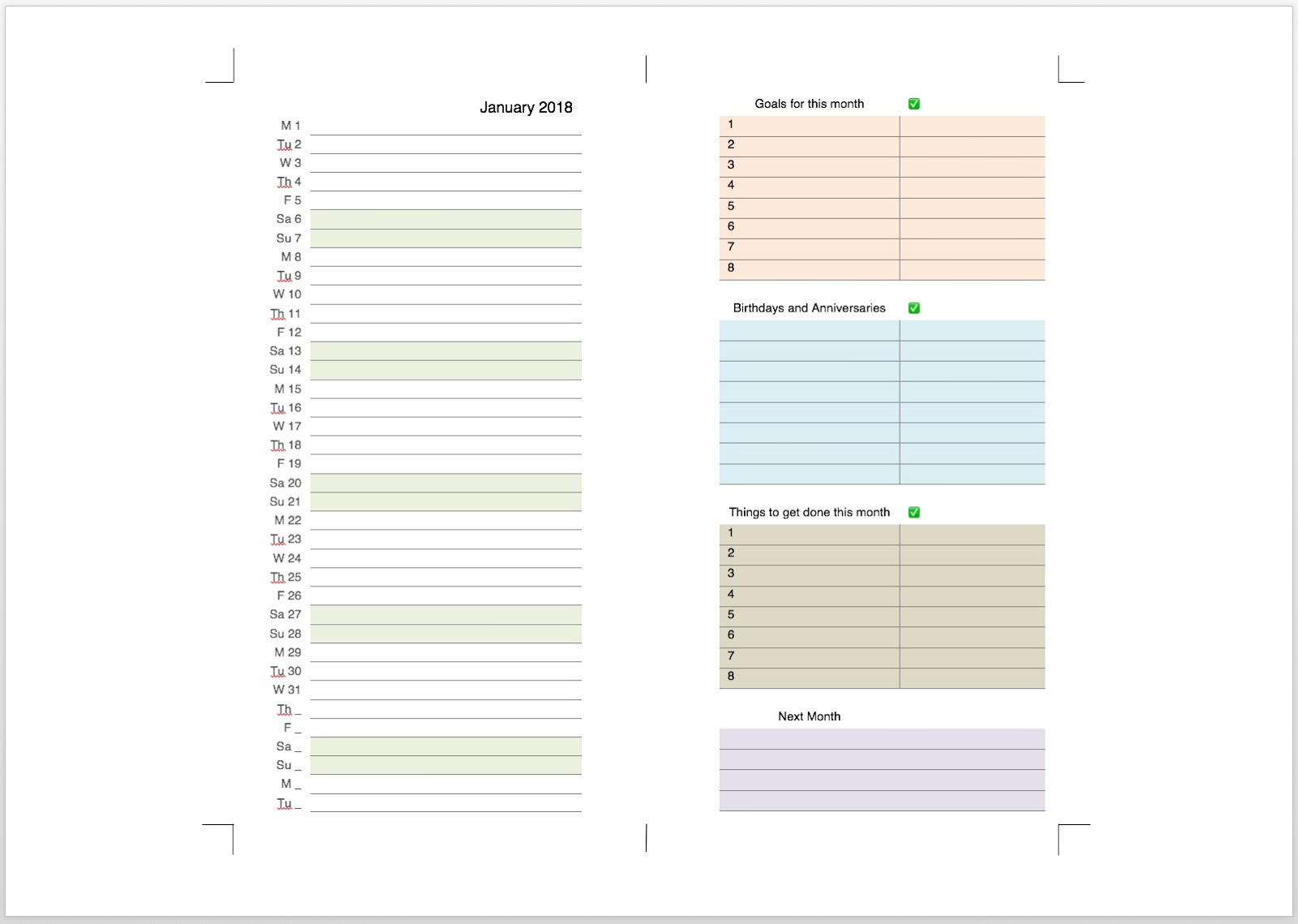
Monthly Overview Diary Insert in A5 and Personal sizes

Last week I published a single insert for just March to give you an overview of the month ahead, it was a bit of an experiment to be honest. I had been kicking this idea around for a little while.

It was also a departure from the normal Philofaxy inserts this was just a one off, no mail merging and colour was added too.

It was one of the most commented on posts for a while, not only on the blog, but also on the two Facebook groups I shared it on.

As a result of the comments and feedback I received I set to work to consider doing a full year and also developing a personal size version too.

I've also included some other changes requested such as the days of the week and changes to the colour shading (I've gone much lighter).

Adding colour makes it more attractive I'm sure, but my choice of colours might not be to your own personal choice, but given the source files you will be able to alter those choices.

There was some advantage to doing it as a single month, at most you only need to allow for 31/32 lines on a page. Doing it as a 12 month file using our normal mail-merge technique it goes up to 37/38 lines. That isn't much of an issue on A5, but on Personal size paper it is a little limiting on line height. However it might work if you have neat hand writing!

With the increased number of lines that also gave me the idea for filling up a small blank space at the bottom right with some notes for 'Next Month'

Of course all the headings and therefore the function of the right hand column sections can be changed if you download and customise the source files.

So today I'm releasing merged versions of the 2018 and 2019 files in the following formats:

A5 formats


You can download and print finished versions for this year from our diary inserts page


Print these on to sheets of A5 paper (scale to fit A5, or scale to 70%)
  • Source files for A5 Word and Excel you will need both. 
There is no difference between both versions only the addition of a single page break after doing the mail merge at the beginning of the merged file, the source files are therefore the same.

In the case of the single sheets, print the odd pages first then reverse the paper to print the even pages.

For the 'Facing Pages' you can print all of these in one pass on personal size paper leaving the reverse side blank, or you can over print the reverse side with a design of your own personal choice. 

Personal formats


Personal on Personal size paper:

All of these are printed on to Personal size paper. In the case of the single sheets, print the odd pages first then reverse the paper to print the even pages.

You can download and print finished versions for this year from our diary inserts page.

For the 'Facing Pages' you can print all of these in one pass on personal size paper leaving the reverse side blank, or you can over print the reverse side with a design of your own personal choice. 
  • Source files for Personal Word and Excel you will need both. 
There is no difference between both versions only the addition of a single page break after doing the mail merge at the beginning of the merged file, the source files are the same.


Personal on A4 Paper: 


You can download and print finished versions for this year from our diary inserts page

These should all be printed single sided and then cut out using the cut marks for guidance and then punched along the centre cut line not on the outer edges. 
  • Source files for Personal Word and Excel you will need both. 
We also have:

Personal on Letter size Paper:

You can download and print finished versions for this year from our diary inserts page.

These should all be printed single sided and then cut out using the cut marks for guidance and then punched along the centre cut line not on the outer edges. 
  • Source files for Personal Word and Excel you will need both. 
I hope you find these new additions to the suite of diary inserts useful. Please report any file issues/dead links to me please. There is a lot of links in this post, all of them have to be entered by hand!

The files will be added to the main list in the next few days once the bugs have been eradicated from the links.... if there are any!

To customise the files you will need to download the relevant source files listed above. When you've made all the changes you like to the template, you can perform a mail merge to create your own insert for any period you like. Check out our Free Diary Inserts link if you want more information on how to do this, including videos at the bottom of the page.

Once again a big thank you to Ray at 'My Life All In One Place' for his hard work and co-operation with helping to create and support us with all these inserts.

This was my first attempt at 'Personal on A4/Letter' it's not difficult to do, but it challenged my knowledge a bit. I will admit compared to other similar inserts I chickened out at doing something on the reverse side of the pages! So I bow to Ray's superior knowledge in the creation of those! 

Creative Commons License
This work by Philofaxy is licensed under a Creative Commons Attribution-NonCommercial 3.0 Unported License. Please download, adapt, use, share, but don't charge or use commercially.