According to an article posted on December 11, 2006 on BusinessWeek.com (and now if this link expires you know how to find it), worldwide sales of Filofaxes have gone up 20% since Letts acquired the company in 2001. Growth is currently at a clip of 5% per year.
The article talks how Letts has endeavored to make Filofaxes more appealing to women customers (who now make up 60% of Filofax purchasers, as opposed to 60% men in the mid-90's), and in developing countries, where Filofaxes are desired as a status item.
Why else has the Filofax held up so well against Blackberries and PDAs? According to the article, people use electronic devices more for "wireless connectivity than as true organizers."
Another interesting statistic: 68% of Filofax users are under the age of 45.

12 January 2007
08 January 2007
Tab Tweaking Two
I explained in my previous post that I've overhauled my tab arrangement. Here's what goes behind each one.
Goals - Not the lofty kind of goals you're probably thinking of. The mundane kind -- swimming a certain number of laps, drinking water, taking fish oil, and so on. I'm much better at doing these things regularly when I keep track of them on little spreadsheets.
Plans - What most people call projects. I like to call them plans so I don't have to break them down into individual projects. A plan can be getting a certain set of work done on the house, or accomplishing something in my career. I like the word "plan" better than "project" because it reminds me about the benefits I'll reap at the end.
Agendas - Running lists of things I need to tell or ask certain people -- one page per person. Borrowed from David Allen (of Getting Things Done fame). I've found this a great way to remember things I want to discuss with a doctor, with a family member I don't see very often, and so on.
Ideas - Anything goes.
Lists - Shopping lists, restaurants to try, books to read, etc.
Addresses - Actually, I only carry telephone numbers on these A-Z pages. My main address list lives on my computer.
You've probably noticed there's no To-Do section. I try to have only one page going at a time, and I keep it in the middle of the current week spread in the calendar.
Goals - Not the lofty kind of goals you're probably thinking of. The mundane kind -- swimming a certain number of laps, drinking water, taking fish oil, and so on. I'm much better at doing these things regularly when I keep track of them on little spreadsheets.
Plans - What most people call projects. I like to call them plans so I don't have to break them down into individual projects. A plan can be getting a certain set of work done on the house, or accomplishing something in my career. I like the word "plan" better than "project" because it reminds me about the benefits I'll reap at the end.
Agendas - Running lists of things I need to tell or ask certain people -- one page per person. Borrowed from David Allen (of Getting Things Done fame). I've found this a great way to remember things I want to discuss with a doctor, with a family member I don't see very often, and so on.
Ideas - Anything goes.
Lists - Shopping lists, restaurants to try, books to read, etc.
Addresses - Actually, I only carry telephone numbers on these A-Z pages. My main address list lives on my computer.
You've probably noticed there's no To-Do section. I try to have only one page going at a time, and I keep it in the middle of the current week spread in the calendar.
07 January 2007
Tab Tweaking
I know, I know, most of us who frequent this blog are aware of the need to do less tweaking and more doing. But I often feel like speaking out in praise of tweaking.
By tweaking I don't mean buying a new Treo, or switching to an all-Filofax system when you have Franklin Covey pages that already do the same thing. (Not that I'm not pretty much guilty on both counts.) I'm talking about smaller, internal tweaking.
I say, don't hesitate to tweak your tabs. Tabs are one of those things that you need to experience in order to make a decision about. In other words, if your Filofax isn't working for you, it may be time to rename your tabs and work with the new configuration for a while.
For example, a couple of weeks ago, I thought that my be-all, end-all tab set was:
Actions,
Projects,
Routines,
Lists,
Notes,
Agendas (with the address pages behind the Agendas tab, and no A-Z tabs)
A couple weeks before that, I was using A-Z tabs and no other tabs, but using a second pop-in ruler to point to my action lists.
Now, I've changed my configuration to:
Goals
Plans
Agendas
Ideas (someday/maybe, etc.)
Lists
Addresses (again, just address pages here, with no A-Z tabs)
What I want to put behind each of these tabs doesn't necessarily follow convention. More on that in my next post.
By tweaking I don't mean buying a new Treo, or switching to an all-Filofax system when you have Franklin Covey pages that already do the same thing. (Not that I'm not pretty much guilty on both counts.) I'm talking about smaller, internal tweaking.
I say, don't hesitate to tweak your tabs. Tabs are one of those things that you need to experience in order to make a decision about. In other words, if your Filofax isn't working for you, it may be time to rename your tabs and work with the new configuration for a while.
For example, a couple of weeks ago, I thought that my be-all, end-all tab set was:
Actions,
Projects,
Routines,
Lists,
Notes,
Agendas (with the address pages behind the Agendas tab, and no A-Z tabs)
A couple weeks before that, I was using A-Z tabs and no other tabs, but using a second pop-in ruler to point to my action lists.
Now, I've changed my configuration to:
Goals
Plans
Agendas
Ideas (someday/maybe, etc.)
Lists
Addresses (again, just address pages here, with no A-Z tabs)
What I want to put behind each of these tabs doesn't necessarily follow convention. More on that in my next post.
03 January 2007
Pool Philofaxy
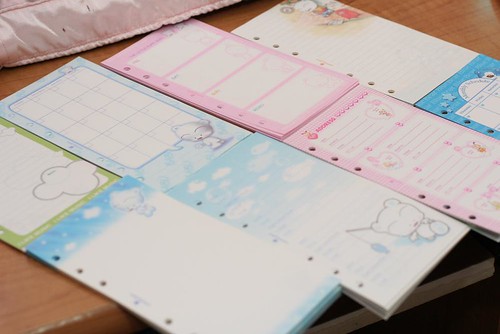 No, I'm not suggesting you toss your precious Filofax into the drink. I'm talking about the Philofaxy pool on Flickr. Check it out (and if you haven't visited for a long time, check it out again)! Members have added some mouthwateringly gorgeous planner shots, like this picture of Morning Glory refills (a Korean stationery brand).
If you ever fear you're losing interest in using your Filo, these pictures will boost your enthusiasm, big time. I know they did mine!
Photo credit to bettybl on Flickr.
01 January 2007
Liability of Literacy
 Has anyone else, like me when I first started using a Filofax, ever worried that writing things down would cause one to forget, rather than remember things? Nowadays, gurus like David Allen and Steven Covey preach the importance of writing everything down, so that it won't get lost before you have a chance to do it.
 An article in the November 20, 2006 issue of The New Yorker suggests that the very fact of being able to read and write has a detrimental effect on memory. In India's Rajasthan region, a caste of bards called bhopas have been known to memorize epics of 100,000 stanzas (6 times the length of the Bible) and sing them straight through.
According to the article ("Homer in India," by William Dalrymple), "...illiteracy seems an essential condition for preserving the performance of an oral epic....This was certainly the conclusion of the Indian folklorist Komal Kothari. In the nineteen-fifties, Kothari came up with the idea of sending one of his principal sources, a singer from the Langa caste named Lakha, to adult-education classes. The idea was that he would learn to read and write, thus making it easier to collect the many songs he had preserved. Soon Kothari noticed that Lakha needed to consult his diary before he began to sing. Yet the rest of the Langa singers were able to remember hundreds of songs--an ability that Lakha had somehow begun to lose as he slowly learned to write."
As the bhopa tradition dies out, transcribing the epics is necessary to preserve them. Inevitably, some have been lost forever, dying along with the traveling bards who could sing volumes, but not write them down.
Photo of quill pen found in 15th century records from www.nationalarchives.gov.uk.
Subscribe to:
Posts (Atom)